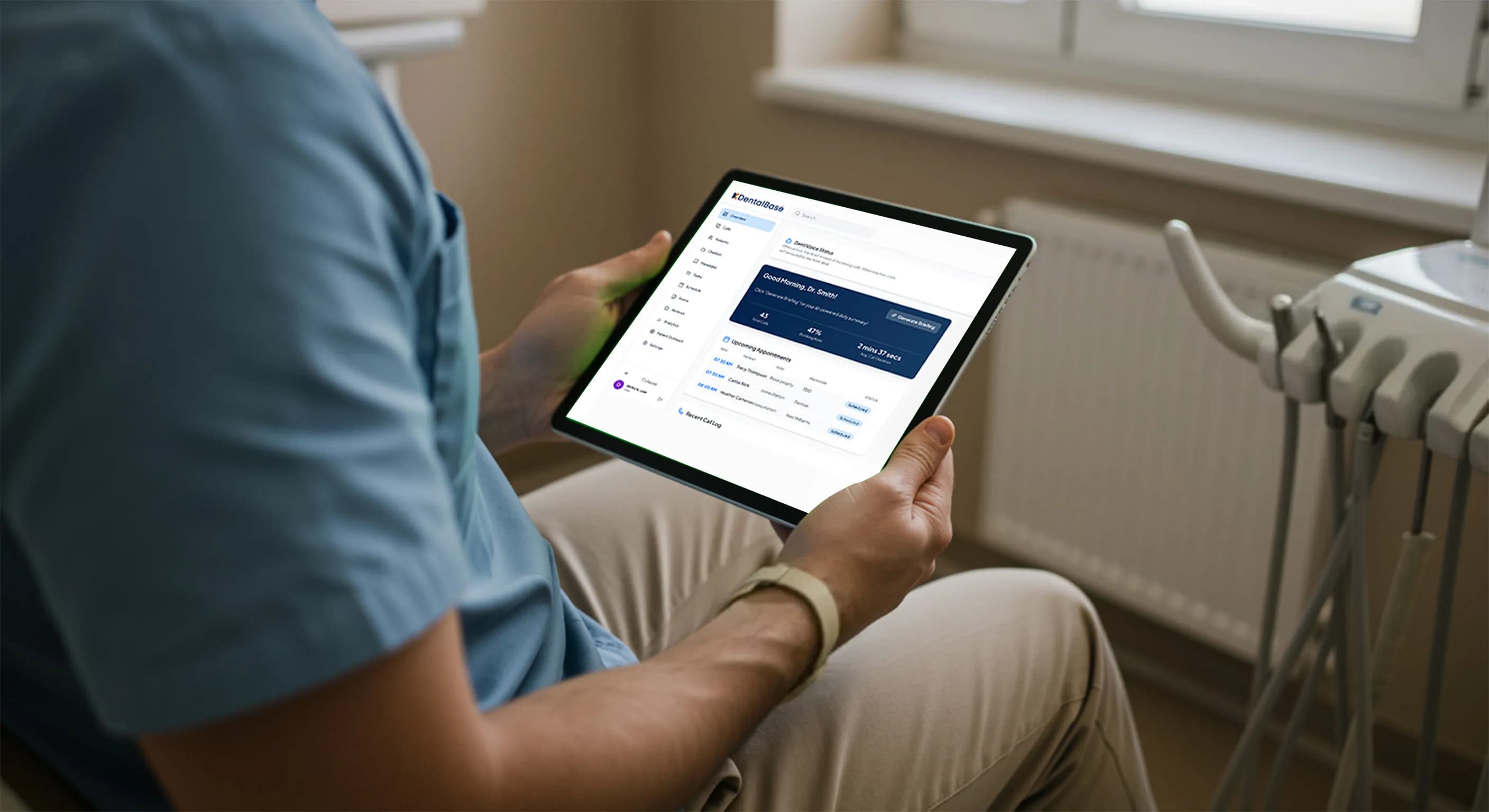
AI in Patient Communication: Uses, Benefits, Limits

See how AI in patient communication speeds up responses, cuts routine calls, and stays HIPAA compliant for dental practices, plus setup steps.
Share:
Table of contents
Introduction
Patients expect fast answers now. They want quick replies, easy booking, and information whenever they need it. AI in patient communication meets that demand by using artificial intelligence to automate routine conversations, scheduling, reminders, common questions, while staff keep handling everything else. That shift is reshaping how practices manage rising call volume without sacrificing quality.
These systems give practices a structured way to do this well. They don't replace your front desk. They work alongside it, handling routine questions so your team can focus on patients who need a real conversation.
Most practices don't need a full rollout to see a difference. A three-provider office fielding 150 calls a week can route the routine ones to AI within a month, while staff keep every call that needs judgment. If you're comparing systems, the 2026 buyer's guide to dental patient communication software breaks down what to check before you sign a contract.
Always On
Answers after hours and during lunch rushes
Multi-Channel
Text, voice, portal, all in sync
Instant Routing
Sorts requests before a human ever sees them
Human Handoff
Complex cases go straight to your team
What Is AI in Patient Communication?
AI in patient communication means using artificial intelligence to handle conversations between your practice and your patients. Unlike a basic auto-reply, these tools understand context. They learn from each interaction and shape their responses around what a patient actually needs, within the rules your practice sets.

AI vs. Traditional Automated Systems
The difference between basic automation and real AI matters for your practice. A traditional system follows rigid if-then rules, and it breaks the moment a question falls outside the script. AI works differently. It reads natural language, picks up on intent, and adjusts its answer to the conversation. Talking to it feels like talking to a person, not pressing buttons on a phone tree.
What Patient Interactions Can AI Handle?
AI communication systems handle a wide range of routine patient interactions, from scheduling to intake. Here's what that typically covers:
- Scheduling, rescheduling, and cancellation requests
- Insurance eligibility checks and basic billing questions
- Prescription refill requests routed to the right provider
- Appointment reminders, confirmations, and post-visit follow-ups
- Pre-visit intake forms and initial symptom triage within set limits
How AI Connects to Your Existing Practice Software
Modern AI platforms plug into your existing practice management system, your electronic health records, and your communication channels. They work across your website, patient portal, text messages, and phone lines. Wherever a patient reaches out, they get the same accurate answer.
Integration quality varies more than most vendors admit upfront. Some platforms sync in real time with practice management software such as Open Dental, pulling live appointment slots instead of a static calendar. Ask for a live demo against your own schedule.
What AI Tools Support Patient Communication?
Practices use several types of AI tools, and each one is built for a different job. Knowing what each does makes it easier to pick the right mix. Below are the three main categories worth understanding.
Messaging and Virtual Assistant Tools
AI-powered chatbots and virtual assistants are the most visible form of this technology. They run on your website, patient portal, and messaging apps, answering common questions the moment a patient asks. The better systems handle multi-turn conversations. They understand a question even when it's phrased oddly, and they know when to hand a conversation off to a human. Most of the workload here is routine: hours, location, insurance, and services. The AI collects whatever details staff need for anything more complex.
Voice and Scheduling Support Tools
Voice-enabled AI systems handle phone calls the same way chatbots handle text: answering, scheduling, and routing without a human picking up first. They connect to your electronic health records and communication platforms, so a call and a text about the same patient stay in sync.
Choosing the Right Mix of AI Tools
Not every practice needs both voice and text AI on day one. Call volume points toward a starting channel. Voice AI vs. text AI for dental receptionists walks through which channel books more appointments for different practice types.
- High call volume, limited staff bandwidth: start with voice AI
- Younger patient base, reminder-heavy workflow: start with text and messaging
- Multi-location groups: run both channels with shared routing rules
Related: Picking between platforms gets easier with a side-by-side breakdown of features and pricing models. How to choose dental AI receptionist software →
What Are the Key Benefits of AI-Powered Patient Communication?
The benefits go well beyond saving money. Patients get faster answers, staff get their time back, and practices run on more consistent information, the kind of shift the ADA's Health Policy Institute has tracked across the industry. Here's where the impact shows up most.
Faster Response Times
Faster replies are the most immediate benefit. A traditional office might leave a patient waiting hours, sometimes days, for an answer. AI answers routine questions instantly. That matters most to patients who'd rather text than call, and it cuts down the frustration of phone tag and delayed emails.
Faster Response
Routine questions get answered on first contact, not the next callback.
Consistent Info
Every patient hears the same policy, regardless of who or what answers.
More Staff Time
Routine calls get automated, freeing staff for complex patient needs.
Better Access
Patients reach the practice on their schedule, not just business hours.
Consistent, Accurate Information
Every patient gets the same accurate answer, whether it's about insurance coverage, appointment prep, or post-treatment care. AI removes the variation that creeps in when different staff members explain the same policy in different ways. The information stays uniform, no matter who or what a patient reaches.
More Time for High-Value Patient Care
Automating routine communication frees up staff for the parts of the job that actually need a person. That means more time for complex patient concerns, clinical care coordination, and the relationship-building that directly shapes patient outcomes.
Better Access for Every Patient
Patients get more flexibility when communication doesn't depend on office hours. Some want to text at 9pm. Others prefer a call during the workday. AI accommodates both, letting patients pick their own channel and timing. That flexibility matters most for working parents, older patients with mobility limits, and anyone managing a chronic condition who contacts the practice often.
How Does AI-Powered Communication Work for Dental Practices?
Dental practices get outsized value from this technology because so much of their communication is routine. High call volume plus repetitive questions creates ideal conditions for AI to take over the busywork.

Appointment Reminders and Confirmations
This is where AI systems shine. They send personalized reminders through a patient's preferred channel, confirm appointments, and log cancellations. They can automatically reschedule missed visits based on open slots and send prep instructions ahead of specific procedures. Advanced systems even flag scheduling conflicts and suggest alternative times before a human has to.
Insurance and Billing Support
Insurance and billing questions eat up a lot of staff time in dental practices. AI can verify coverage and benefits, explain common billing procedures and payment options, and give patients claim status updates. It can also collect payment on outstanding balances. These systems pull from real-time insurance databases and your practice management software, so the answer a patient gets is current, not a guess.
Practices running Dentrix alongside an AI receptionist often see the biggest time savings here. Eligibility checks pull directly from synced patient records instead of a separate manual lookup.
Pre-Visit and Post-Visit Communication
Good pre-visit and post-visit communication keeps patients informed without pulling clinical staff into every conversation. AI can send instructions tailored to a scheduled procedure, follow up with care guidelines and medication reminders, and collect feedback after treatment. It can also flag patients who need a follow-up appointment.
| Communication Type | Traditional Method | AI-Enhanced Method |
|---|---|---|
| Appointment Reminders | Manual calls/texts by staff | Automated, personalized messages |
| Insurance Verification | Phone calls during business hours | Real-time online verification |
| Post-Treatment Care | Printed instructions only | Interactive follow-up sequences |
Some of this starts before the patient ever calls. Digital intake forms can feed straight into the same AI system, so a new patient's history is already on file by the time they walk in.
Why Dental-Specific AI Works Differently
Dental-specific AI understands dental terminology and connects to dental practice management software out of the box. It's also built to handle the common patient concerns unique to dental care, from procedure anxiety to oral health basics that come up in nearly every conversation.
Related: If your practice is still weighing voice-first AI against a text-first rollout, a platform comparison can shortcut the research. Top dental AI voice receptionist platforms in 2026 →
Is AI-Assisted Patient Communication HIPAA Compliant?
Healthcare practices adopting AI-based patient communication must navigate strict regulatory requirements to protect patient privacy. Health information is sensitive, and the rules around AI are still evolving, so this isn't a box you check once and forget.
HIPAA Requirements for AI Communication Tools
HIPAA sets strict rules for handling protected health information in every patient communication. AI systems must encrypt patient data in transit and at rest. Access controls should limit who can see that data, and the vendor needs to maintain audit logs of every interaction. A business associate agreement has to cover the AI vendor specifically, not just your practice's other software. Verify this before you sign anything.
The HHS Office for Civil Rights treats an AI vendor the same as any other business associate touching protected health information. The contract needs to name specific safeguards. A general compliance claim in marketing copy isn't enough.
The stakes aren't abstract, either. HHS's tiered civil penalty structure allows fines up to $1.5 million per violation category each year.
Data Security Beyond Basic HIPAA
Good vendors go further than the minimum HIPAA requires. Look for secure data storage, regular security assessments and penetration testing, and a clear incident response plan for potential breaches. Staff should also get training on AI-specific security protocols. Ask vendors for transparent reporting on their security measures and certifications, not just a checkbox claim.
Ask for their SOC 2 report for AI dental receptionists rather than taking a security claim at face value. The HIPAA Privacy Rule also requires practices to retain vendor agreements and audit logs for six years.
Patient Consent and Transparency
Patients deserve to know when they're talking to a machine. Tell them upfront, explain how their information gets used and stored, and offer an opt-out for anyone who wants a human instead. Get explicit consent before an AI system processes sensitive health information.
Setting Appropriate Use Boundaries
AI should stay inside its lane. It shouldn't offer medical advice beyond simple, pre-approved information. Clear escalation rules need to route complex medical questions to a qualified provider, and a human should review AI interactions regularly for accuracy. These boundaries protect both patients and your practice. Done right, they let AI support care quality instead of undermining it.
Evaluating an AI receptionist for HIPAA compliance covers the questions to ask before you expand its use.
Quick Compliance Check Before You Sign
- Business associate agreement covers the AI vendor by name
- Patient data is encrypted in transit and at rest
- Access logs exist for every patient interaction
- Patients are told when they are talking to AI
- A clear opt-out path exists for human-only contact
The limits are real, but so is the direction of travel. We cover why instant, always-on patient communication is becoming the dental standard in a separate piece.
Does AI Replace Staff or Support Them?
No, well-implemented AI doesn't replace staff. It's a common misconception that these systems exist to cut headcount. In reality, AI enhances what your team can do, freeing people up for work that needs empathy and clinical judgment.
AI Handles
- Routine scheduling and reminders
- Repetitive insurance questions
- After-hours and overflow calls
Your Team Handles
- Clinical questions and treatment concerns
- Upset or anxious patients
- Complex billing and insurance disputes

What AI Takes Off Your Team's Plate
AI handles the routine, repetitive work that eats staff time without needing human judgment: appointment confirmations, basic scheduling changes, insurance verification, and standard procedure explanations. That frees your team for complex patient concerns, clinical coordination, and the relationship-building that shapes patient outcomes.
When AI Hands Off to a Human
Good AI knows its limits. When a conversation needs medical expertise, emotional support, or real problem-solving, it should transfer to staff without the patient having to ask twice. That handoff, done well, combines AI's speed with your team's judgment.
Handoffs are where most systems succeed or fail. What a good AI-to-human handoff looks like and how AI should handle a frustrated caller are worth reading first.
What This Means for Staff Morale
Less administrative burden means more time for meaningful patient work. Instead of hours on routine calls, staff can focus on care coordination and patient education, the work that builds loyalty. Many practices see morale improve too. Most people got into healthcare to help patients, not manage a phone queue.
How Do You Get Started With AI Patient Communication?
Start with a needs assessment, then move through vendor evaluation, staff training, and ongoing monitoring to build genuine patient acceptance. Rushing straight to implementation without this groundwork is the most common way rollouts stall.
- Assess your practice's needs and current call volume
- Evaluate AI vendors on compliance, integration, and support
- Train staff on escalation paths and monitoring
- Monitor performance and adjust based on real data
Assess Needs
Evaluate Vendors
Train Staff
Monitor & Adjust
Step 1: Assess Your Practice's Needs
Start by measuring what's actually happening today: call volume, common pain points, and patient preferences. Document your current process, capture baseline metrics, and pin down where AI could help most. This keeps you from buying a solution to a problem you don't have.
Step 2: Evaluate AI Vendors
Look past the sales pitch. Request a demo of the AI handling real patient scenarios, verify HIPAA compliance and security certifications, and check how it integrates with your practice management system. Ask about training and support too. AI vendors should be upfront about what their technology can and can't do.
A setup checklist for getting live within a week helps sequence the rollout.
Step 3: Train Your Staff
Training determines whether adoption actually sticks. Cover what the AI can and can't do, escalation procedures, monitoring practices, and how to communicate well with patients. Staff need to see how AI supports their role instead of threatening it.
Step 4: Monitor Performance and Adjust
Set clear performance indicators, and review AI interactions regularly for accuracy. Collect patient feedback and adjust based on what the data actually shows. Ongoing monitoring is what keeps these systems delivering real benefits instead of drifting off course.
Explore More on AI Dental Receptionists
See how practices like yours are using AI receptionists across scheduling, compliance, and patient experience.
Browse the Category →Conclusion
AI in patient communication gives healthcare practices a real opportunity to improve patient experience and run more efficiently. The technology has matured enough to handle complex interactions, as long as there's proper oversight and integration into how your practice already works.
The Bottom Line
Faster response times, consistent information, and freed-up staff time make these systems a solid investment for practices trying to keep up with what patients expect. Getting there still takes work: compliance, staff training, and ongoing monitoring all matter.
Why Dental Practices Benefit Most
Dental practices in particular benefit here. Appointment management, insurance verification, and treatment follow-up are exactly the kind of routine, repetitive tasks AI handles well, which frees your team to focus on clinical care and the patients who need real attention.
What's Next
This technology will keep evolving as natural language processing, voice recognition, and integration options improve. Practices that adopt it thoughtfully now will be ready for what comes next, without losing sight of patient care or regulatory compliance.
The goal isn't replacing human interaction, it's strengthening it. Done right, AI keeps communication consistent and timely while your team spends its time on the clinical expertise and empathy patients actually value. That balance, not the technology alone, is what makes this work.
Communication automation works well as part of a broader intake strategy. A full walkthrough of dental patient intake automation covers the setup and HIPAA requirements behind it.
Frequently Asked Questions
AI in patient communication uses artificial intelligence to handle interactions between healthcare providers and patients, including chatbots for scheduling, automated call routing, and smart messaging. These tools rely on natural language processing to understand patient needs and respond appropriately.
Yes, when properly implemented. Practices need encryption, access controls, audit logs, and a signed business associate agreement with the AI vendor. Compliance also requires ongoing monitoring, since certification alone does not guarantee every integration point protects patient data.
No, AI is not meant to replace human staff. It handles routine tasks like scheduling and basic questions, while staff manage complex patient needs, emotional support, and clinical judgment. Effective practices combine AI automation with human expertise rather than choosing one over the other.
In dental practices, AI handles appointment reminders, post-treatment follow-ups, and common questions about procedures. Chatbots help patients schedule visits and get pre-visit instructions, while smart phone systems route calls efficiently and support patient education with oral health guidance.
Yes, most AI patient communication platforms sync with practice management software like Dentrix or Open Dental. Integration quality varies by vendor, so confirm real-time syncing rather than manual data exports before signing a contract.
Well-designed AI systems escalate the conversation to a staff member automatically. The AI recognizes questions requiring medical judgment, billing disputes, or emotional support, and transfers the patient rather than guessing at an answer.
Sources & References
- 1
- 2
- 3
- 4
- 5
Was this article helpful?
Written by
DentalBase Team
Expert dental industry content from the DentalBase team. We provide insights on practice management, marketing, compliance, and growth strategies for dental professionals.