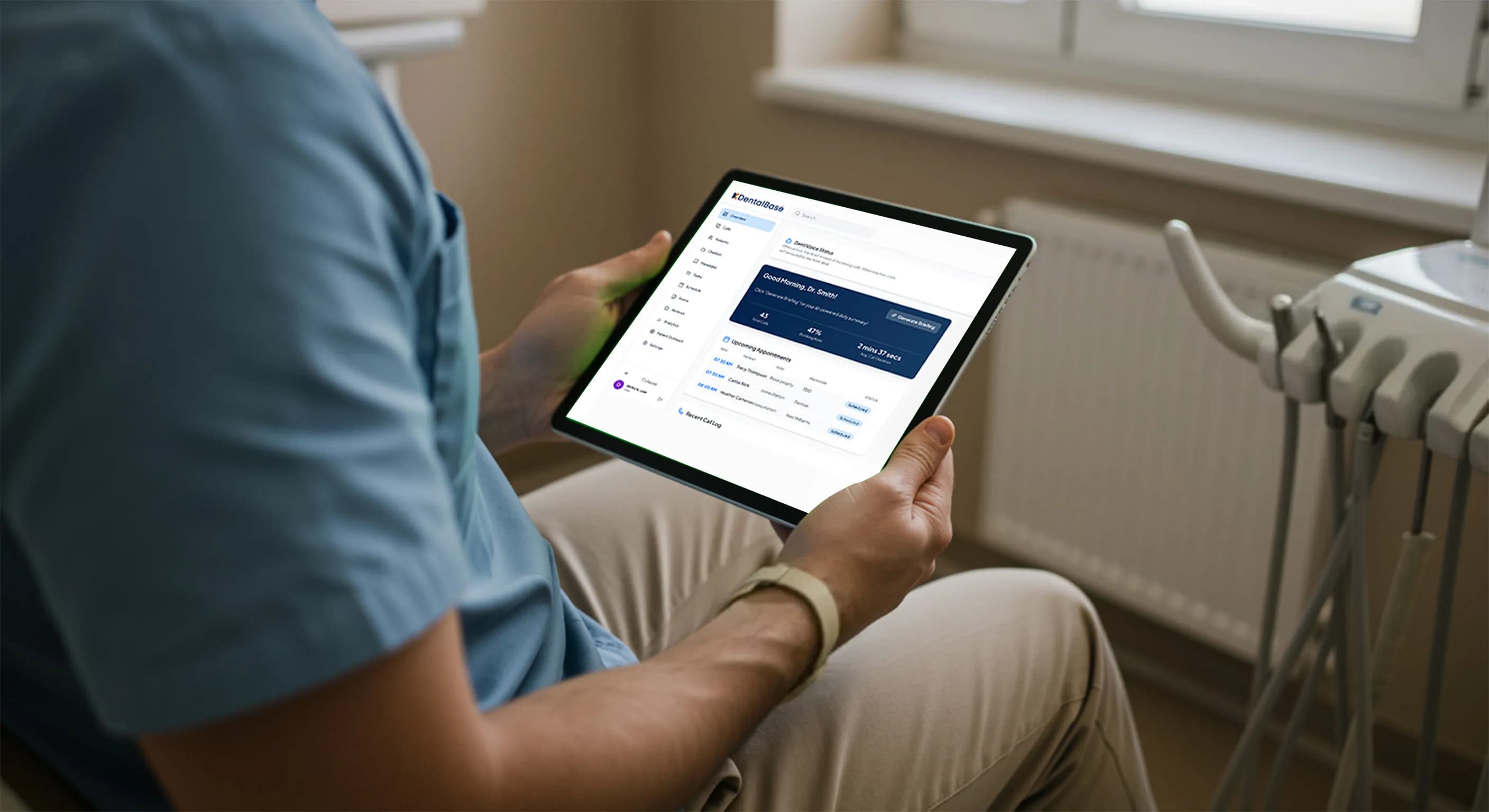
AI Patient Communication Platform: Dentistry's Next Step

An AI patient communication platform is redefining dental care. See how it improves scheduling, response times, and the dental patient experience.
Share:
Table of contents
An AI patient communication platform is changing how dental practices talk to patients. Dental care is no longer judged only by clinical outcomes. Patients expect fast replies, easy scheduling, and clear communication at every touchpoint.
Traditional front desk workflows struggle to meet that standard. The phone rings while another patient is being checked out. A text arrives at 9pm and sits unread until morning. That gap is why these systems are becoming standard equipment, alongside the tools covered across our AI dental receptionist resources.
AI is not only improving efficiency. It is reshaping how patients experience dental care, from the first phone call to post-visit education.
What Is an AI Patient Communication Platform?
It is software that uses artificial intelligence to answer, route, and resolve patient conversations across phone, SMS, and web channels. It books and confirms appointments, answers routine questions, and hands anything clinical or sensitive to your team.
The category sits between a phone system and practice management software. It does not replace either. It sits in front of both and handles the conversation before the data lands in your schedule.
These platforms go well beyond scheduled reminder blasts. A reminder system sends the same message on a timer. A conversational system reads what the patient actually wrote or said, checks the schedule, and responds with an answer that fits that patient.
Core Capabilities
- Two-way messaging via SMS and WhatsApp
- AI-powered phone answering
- Appointment scheduling and confirmations
- Automated recalls and follow-ups
- Intelligent escalation to staff
The result is always-on, personalized communication without adding hours to the front desk workload. If the category itself is new to you, start with our guide to what an AI dental receptionist is, then read how natural language processing lets it understand callers.
Why Does Traditional Patient Communication Fall Short?
Traditional communication falls short because it depends on one person being free at the exact moment a patient reaches out. A phone-first front desk can hold only one conversation at a time, and it goes dark the moment the practice closes for the evening or the weekend.
The American Dental Association's guidance on handling calls from prospective patients treats that first phone call as the point where a practice wins or loses a case. Dentaltown contributors have argued the same point for years: a new patient call is a sales conversation with a short fuse, and the caller rarely waits around.
Common Patient Pain Points
- Long hold times
- Missed calls
- Slow responses to messages
- Limited after-hours availability
Run the arithmetic on availability and the problem gets concrete. A practice open 40 hours in a 168-hour week is reachable for about 24% of it and unreachable for the other 76%. If eight of every ten calls are answered, another 20% of inbound demand never reaches a person at all. Every toothache, insurance question, and reschedule request that lands in the other 76% either waits or goes to whichever practice picks up. An anonymous phone audit of your own front desk usually makes that gap visible faster than any report.
How Does AI Transform the Dental Patient Experience?
AI transforms the experience by removing the waiting. The system answers on the first ring. It replies to a text in seconds and books directly into open slots. The patient finishes the task in one interaction instead of leaving a voicemail and hoping for a callback.
Instant Responses, 24 Hours a Day
Patients expect immediate answers. They judge a practice on how quickly it responds. A conversational AI system replies instantly to inquiries, handles after-hours questions, and removes the voicemail dead end entirely.
Faster responses lead to higher satisfaction and more booked appointments, because the window in which a motivated patient will act is measured in minutes, not days. The platform also logs every interaction, so the morning huddle starts with a complete picture of what came in overnight rather than a stack of voicemails.
Personalized Engagement at Scale
Personalization stops being a time cost once the system carries the context. AI can remember patient preferences, reference past appointments, and tailor reminders and follow-ups to the treatment a patient is actually in the middle of.
Patients feel recognized rather than processed. A hygiene recall that names the last visit date reads very differently from a generic blast, and the difference shows up in confirmation rates. Accuracy matters here too, which is why appointment type mapping has to be configured correctly before any of this is switched on.
How Does AI Reduce Front Desk Stress and Missed Appointments?
AI reduces both by absorbing the repetitive traffic that fills a front desk day. Confirmations, reminders, directions, hours, and routine insurance questions run automatically, which frees the coordinator for the conversations that need judgment and leaves fewer gaps in tomorrow's schedule.
Reduced Stress for Front Desk Teams
A better patient experience starts with a supported team. AI automates appointment reminders, confirmation requests, and common FAQs, which creates calmer front desks and more attentive in-office interactions.
That matters more than it used to. Staffing has ranked among dentists' leading business challenges in recent ADA Health Policy Institute practice research, with roughly 62% of dentists naming staffing and recruitment as their top business concern. ADA HPI reporting also found that 91.7% of dentists recruiting a hygienist in 2024 called the process very or extremely challenging, and that only 32.7% of dentists expressed confidence in the U.S. economy in the fourth quarter of 2025. When the front desk is short a person, automation is what keeps the phones covered. Rolling it out well depends on how you introduce the system to your team.
Fewer Missed Appointments
Missed appointments cost the practice production and cost the patient their treatment timeline. AI platforms send timely reminders, allow rescheduling in a single reply, and keep nudging unconfirmed slots until someone responds.
Reliable communication builds patient accountability. Outbound messaging carries its own rules, so review TCPA requirements for outbound calls and texts before you widen any reminder cadence.
What Does an AI Platform Actually Handle Versus Your Team?
The split is simpler than most practices expect. Routine, rules-based, high-volume conversations go to the platform. Clinical judgment, upset patients, complex treatment planning, and financial negotiations stay with your team, with the AI passing context across at handoff.
| Conversation type | Handled by AI | Escalated to staff |
|---|---|---|
| Booking a cleaning | Yes | Only on conflict |
| Hours, address, parking | Yes | No |
| Reschedule or cancellation | Yes | Rarely |
| Dental emergency triage | Intake only | Always |
| Treatment plan questions | No | Always |
| Billing disputes | No | Always |
The escalation rules matter more than the automation rules. A patient in pain at 10pm should reach a triage path within one exchange, not after four clarifying questions. Practices that get this wrong usually automated too much too early rather than too little.
A reasonable first target is automating the routine 60% to 70% of inbound volume and routing the rest. Mapping this split honestly before launch is what keeps patients from feeling handed off to a wall. Our breakdown of which dental office calls an AI receptionist handles covers the edge cases in more depth.
How Do You Roll Out an AI Patient Communication Platform?
Roll it out in stages rather than all at once. Start with a single channel and a narrow set of conversation types, confirm the booking logic is correct against your real schedule, then widen the scope week by week as the team gains confidence in what the system is saying.
- Audit the current baseline. Count missed calls, after-hours voicemails, and average response time for a full week before anything changes.
- Map appointment types and scheduling rules. The AI can only book correctly if your columns, durations, and provider rules are documented.
- Start with after-hours coverage. The lowest-risk window is the one where nobody is answering today.
- Add daytime overflow. Let the platform pick up calls that would otherwise go on hold.
- Turn on proactive messaging. Reminders, confirmations, and recalls come last, once inbound handling is proven.
- Review transcripts weekly. Escalation rules need tuning against real conversations, not assumptions.
Build in a fallback path as well, because phone infrastructure fails occasionally and patients should never hit a dead line. Planning for dental phone system failover belongs in the rollout, not in the post-mortem.
Is AI Patient Communication Secure and Compliant?
It can be, provided the vendor is built for healthcare. A platform handling appointment details and patient names is touching protected health information, so it needs a signed business associate agreement, encryption in transit and at rest, access controls, and audit logging as baseline requirements.
The ADA has been explicit that AI in dentistry needs a governance framework rather than blind adoption. Its standards work on artificial intelligence in dentistry sets expectations around safety, transparency, and patient privacy, and ADA News has reported on the standards now guiding responsible AI use.
Consent rules apply to outbound messaging as well as inbound. Reminder cadences, recall campaigns, and reactivation texts all sit under telephone consumer protection rules, and a platform that cannot document opt-out handling is a liability rather than an asset.
Ask vendors for specifics rather than assurances. Our walkthrough of HIPAA compliance for AI receptionists lists the questions worth asking before a contract is signed.
Why DentiVoice Leads the Future of Dental Communication
DentiVoice is built specifically for dental patient engagement rather than adapted from a general-purpose chatbot. It understands dental vocabulary, dental scheduling logic, and the difference between a routine recall and a caller in pain who needs a person.
What Sets DentiVoice Apart
- Dental-trained conversational AI
- Multi-channel communication across SMS, WhatsApp, and phone
- HIPAA-compliant messaging
- Integration with existing practice workflows
- Scalable for single practices and DSOs
The distinction shows up in the details. A general chatbot hears "my temporary came off" and offers a booking link. A dental-trained system recognizes an urgent restorative issue, checks for same-day availability, and flags the conversation for the team.
DentiVoice turns communication into a competitive advantage, and it does so without changing who your patients talk to when a conversation needs a human. The case for adoption is laid out in full in our piece on why every modern dental practice needs an AI receptionist.
What Comes Next for Dental Patient Experience?
Expect these systems to move from differentiator to baseline expectation. Patients already book restaurants, flights, and retail returns without speaking to anyone, and they are applying that standard to healthcare scheduling faster than most practices are adapting.
What Is Coming
- Predictive patient outreach based on recall patterns
- Voice-enabled interactions that match the quality of a live call
- Fully automated scheduling journeys from first contact to confirmation
- Deeper personalization drawn from practice data
Voice quality is the fastest-moving piece. Callers who would have identified an automated system instantly two years ago now finish the booking without noticing, which shifts the question from whether patients will accept it to whether the practice has configured it properly.
Practices adopting AI communication now will set the standard others are measured against in a few years. Those waiting will be answering the same phone the same way while their patients quietly compare them to something faster.
See what AI communication changes in your practice
Start with the fundamentals and work out where automation fits your front desk today.
Conclusion: AI Is No Longer Optional
Patient expectations have changed, and they are not going back. An AI patient communication platform lets a practice answer faster and follow up consistently. It protects the team's attention. It delivers an experience that holds up against every other service patients use.
The right system empowers dental practices to:
- Respond faster across phone and text
- Engage patients with context rather than generic blasts
- Reduce the repetitive load on front desk teams
- Deliver a consistent patient experience at every hour
None of this removes the human part of dentistry. It removes the part where a patient has to wait on hold to ask what time their cleaning is.
The practices that move first are not the ones with the largest budgets. They are the ones that documented their scheduling rules, picked one channel, and started.
With a dental-specific system like DentiVoice, AI becomes a dependable partner in modern dental care rather than one more piece of software the team has to manage.
Frequently Asked Questions
Yes. An AI patient communication platform lets patients book, confirm, or reschedule by text or through the practice website at any hour. The request writes straight into the schedule, so there is no callback wait and no voicemail involved.
A dental-specific platform will. It is trained on dental vocabulary, procedures, and scheduling logic, so it recognizes the difference between a routine cleaning request and a cracked crown. Anything outside its scope is escalated to a team member with the conversation history attached.
It is when the vendor is built for healthcare. Look for a signed business associate agreement, encryption in transit and at rest, role-based access controls, and audit logging. Ask for documentation of each before signing rather than accepting a general compliance claim.
No. AI handles repetitive, rules-based conversations so the team has more attention for clinical care, anxious patients, and treatment discussions. Emergencies, treatment planning, and billing disputes are routed to a person every time.
Yes. Smaller practices often see the clearest gain because a single front desk person cannot cover overflow and after-hours calls alone. The platform scales down to a solo office as readily as it scales up to a multi-location group.
Most practices start with after-hours coverage within a couple of weeks, then widen scope over the following month. The bottleneck is usually documenting appointment types and scheduling rules, not the technology itself.
Sources & References
- 1
- 2
- 3
- 4
- 5
- 6
Topics
Was this article helpful?
Written by
DentalBase Team
Expert dental industry content from the DentalBase team. We provide insights on practice management, marketing, compliance, and growth strategies for dental professionals.