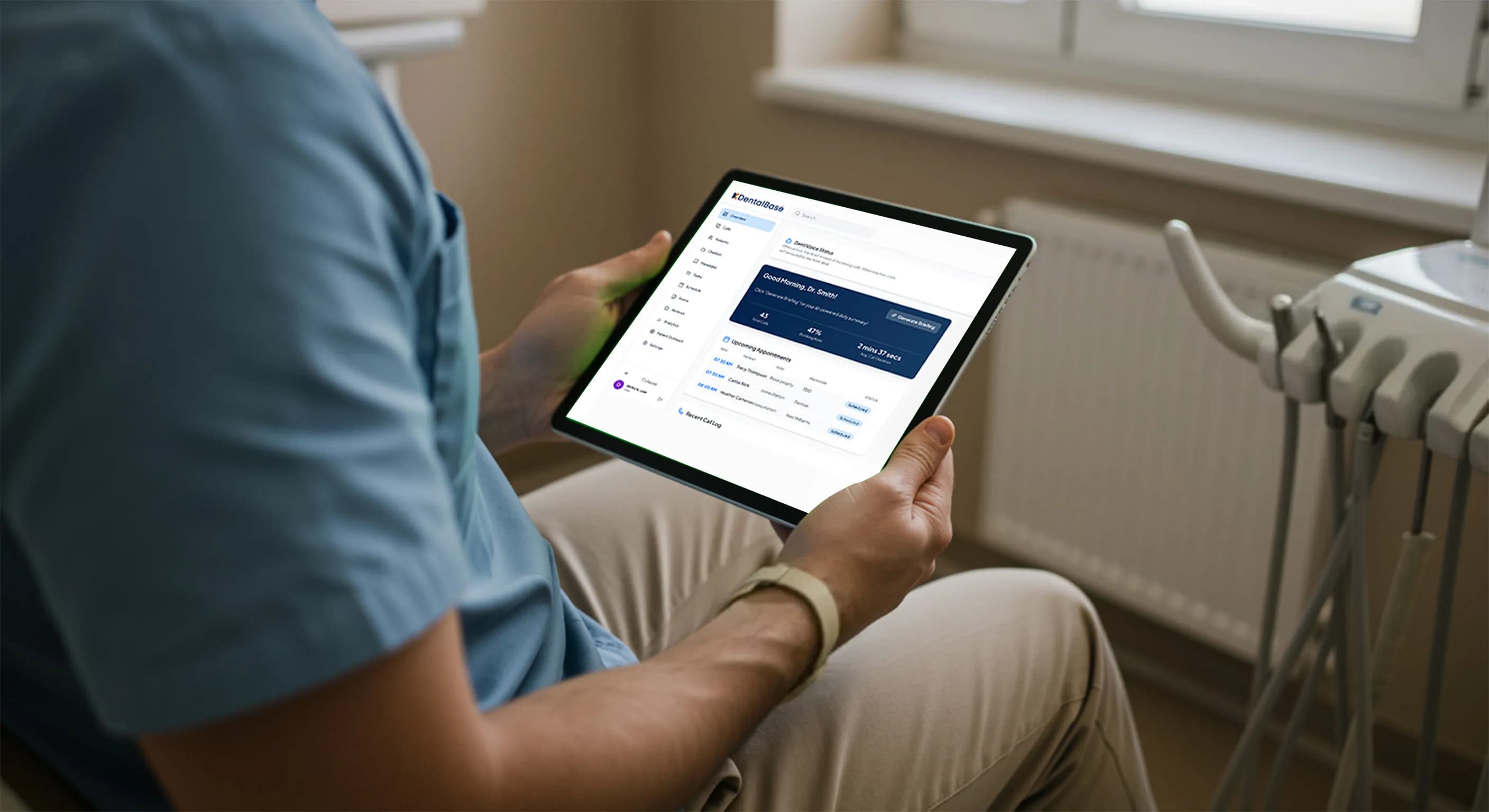
What Is an AI Dental Receptionist? A Complete Guide

An AI dental receptionist answers calls, books appointments, and covers after-hours gaps. Learn how it works, what it handles, and how to evaluate it.
Share:
Table of contents
An AI dental receptionist is voice software that answers a dental office’s phone calls, books appointments, and covers the front desk after hours. This guide explains what an AI dental receptionist does, how it works, and how to evaluate one for your practice.
In many dental practices, the front desk is under constant pressure. Phones ring while patients are checked in. Scheduling overlaps with insurance questions. After hours, calls often go unanswered. Over time, these patterns affect appointment conversion, patient trust, and staff workload.
AI dental receptionist software has emerged to address these challenges. This guide explains what an AI dental receptionist is, how it works in real practices, when it makes sense to adopt, how to roll it out responsibly, what risks to consider, and how owners can evaluate success.
Throughout this guide, the term AI dental receptionist refers to voice software that answers patient phone calls in natural language, follows rules your practice defines, and hands off to a human whenever a call needs judgment. It is a front-office tool, not a clinical one. If you are weighing it against a live answering service or basic voicemail, the later section on how an AI receptionist compares to traditional phone coverage breaks down where each option fits.
Why Does Front Desk Communication Break Down in Dental Practices?
Front desk communication breaks down because a single team is asked to greet patients, verify insurance, manage the schedule, and answer the phone at the same time. When call volume spikes, the phone is usually the task that gets dropped first, which sends new and existing patients to voicemail.
Dental front desks operate under a structural conflict: the patient standing at the counter is visible, while the patient calling is not. Staff naturally prioritize the person in front of them, so inbound calls compete for attention that is already committed. The result is predictable rather than random. Calls cluster at open, around lunch, and near close, and those are exactly the windows when the desk is least able to pick up. Industry coverage in outlets such as Dental Economics has long described front-desk overload as one of the most persistent operational strains in private practice, and the phone is where it shows up first.
The downstream cost is not only a missed call. It is a missed appointment request, an unanswered question about an emergency, and a quiet signal to the caller that another office might answer faster. Recognizing the signs of an overloaded desk early gives owners more options. For a deeper diagnostic, see this guide on the warning signs of an overwhelmed dental front desk.
What Is an AI Dental Receptionist
An AI dental receptionist is a virtual assistant that uses artificial intelligence to answer phone calls, respond to patient questions, schedule appointments, and manage routine front-desk tasks for dental practices.
In practice, an AI dental receptionist works as software that answers incoming patient calls, responds to routine questions, captures appointment requests, and routes calls based on rules defined by the dental practice.
Unlike basic phone automation, AI dental receptionist software is designed around dental workflows. It supports front desk teams by handling predictable communication while escalating complex or urgent situations to human staff.
One example of this category is Dentivoice, which allows practices to configure how calls are handled and when staff involvement is required.
The category itself is not new in concept, only in capability. Practices have always needed someone to answer the phone after hours or during a rush. What changed is that natural-language voice models can now hold a real conversation, recognize why a patient is calling, and act on it within practice-defined limits. For a longer view of how this role developed, see how dental reception evolved from phone trees to AI voice agents. If you want the task-by-task breakdown rather than the definition, the companion guide on what an AI dental receptionist actually does day to day covers each function in detail.
What Does an AI Receptionist Do?
An AI receptionist’s role is operational support, not decision-making. In dental practices, it is typically responsible for:
-
Answering inbound calls immediately
-
Identifying caller intent through natural conversation
-
Responding to common questions about hours, location, and services
-
Capturing appointment requests and cancellations
-
Routing urgent or complex calls to staff
-
Documenting call summaries for follow-up
By handling these repeatable interactions consistently, AI receptionists reduce front desk interruptions and help prevent missed opportunities without removing human oversight.
What Problems AI Dental Receptionists Are Designed to Solve
AI dental receptionists are not intended to replace front desk staff. They are designed to remove communication bottlenecks that strain daily operations.
Common problems practices address include:
-
Missed calls during peak hours
-
After-hours appointment requests going to voicemail
-
Front desk task switching and cognitive overload
-
Inconsistent answers to common patient questions
-
Staff burnout caused by constant interruptions
By absorbing routine communication, AI receptionist software helps stabilize workflows rather than disrupt them.
How AI Dental Receptionists Improve Front Desk Operations
The value of AI reception becomes clearer when viewed through day-to-day front desk challenges.
| Front Desk Challenge | Without AI Support | With AI Dental Receptionist |
|---|---|---|
| Missed calls during peak hours | Calls roll to voicemail or hold | Calls answered immediately |
| After-hours appointment requests | Delayed until next business day | Requests captured and documented |
| Front desk interruptions | Staff pulled away from patients | Routine calls handled automatically |
| Inconsistent answers | Varies by staff member | Consistent, rule-based responses |
| Call volume spikes | Longer wait times | Multiple calls handled simultaneously |
| Staff burnout risk | High during busy periods | Reduced cognitive load |
What Is the Role of AI in Dentistry?
The role of AI in dentistry is primarily operational and analytical, not clinical replacement. AI supports dental practices by improving efficiency, consistency, and access to care-related information.
In the front office, AI is most commonly used to improve patient communication, scheduling reliability, and responsiveness. Rather than replacing human judgment, AI helps practices manage scale, reduce friction, and maintain service quality as demand increases.
AI dental receptionists are one of the earliest and most practical examples of AI adoption because they address a clear, measurable operational problem: missed and delayed communication.
That practicality is why front-office automation tends to arrive before clinical applications in most offices. The phone is a contained, rules-friendly problem with an obvious payoff, so it is a sensible first step into the technology rather than a leap. Owners who start here build confidence with a low-risk workflow before considering anything more ambitious.
How AI Dental Receptionist Software Works
Most AI dental receptionist platforms follow a structured process.
Call Intake
Incoming calls are answered immediately, and patient intent is identified through conversational prompts.
Rule-Based Handling
Calls are handled according to practice-defined rules. Routine questions are answered automatically, appointment requests are captured, and urgent situations are flagged.
Escalation
When a request falls outside defined rules, the call is routed to staff or documented for follow-up.
Integration
Many systems integrate with practice management software so schedules, hours, and policies remain aligned.
This structure gives practices control over automation boundaries.
How a single patient call moves through an AI dental receptionist
The practice sets the boundary between automated handling and human escalation; the software does not decide it on its own.
How Does an AI Dental Receptionist Decide What to Handle and What to Escalate?
An AI receptionist decides using rules the practice defines in advance, not independent judgment. Routine, low-risk requests are completed automatically, while anything urgent, ambiguous, or outside scope is escalated to a human or captured as a structured message for follow-up.
The escalation boundary is the single most important configuration choice an owner makes. Set it too narrow and patients get bounced to staff for questions the software could have answered; set it too wide and a genuinely urgent caller waits in an automated flow. Most practices tune this boundary in the first few weeks by reviewing call transcripts and adjusting which intents trigger a handoff. The goal is a clean split: predictable tasks stay automated, and human attention is reserved for the calls that truly need it. To see how triage logic separates urgent from routine traffic, this overview of automated call handling versus traditional answering is a useful reference.
What Skills Does an AI Receptionist Need?
While AI does not have “skills” in the human sense, effective AI dental receptionists must demonstrate several functional capabilities:
-
Strong natural language understanding for dental terminology
-
Context awareness to distinguish routine from urgent calls
-
Rule adherence to ensure consistent responses
-
Escalation recognition to protect patient experience
-
Accurate documentation for staff follow-up
When these capabilities are well configured, AI supports staff rather than creating additional cleanup work.
The opposite is also true: a poorly tuned setup that misreads intent or escalates the wrong calls quickly erodes trust with the team. That is why configuration and ongoing review matter as much as the underlying technology. The capability list above is only useful when it is matched to how your specific office actually answers the phone.
What an AI Dental Receptionist Typically Handles Well
AI receptionist software is well-suited for:
-
Appointment requests and confirmations
-
Office hours and location questions
-
General service inquiries
-
After-hours call coverage
-
Message capture and structured follow-up
Human staff remain essential for nuanced conversations, billing disputes, and complex clinical coordination.
Drawing that line clearly is part of a healthy rollout. The automated layer should own the high-volume, low-judgment work so the team can give full attention to the conversations that genuinely benefit from a human voice. Mapping which call types belong on each side of that line is one of the most useful exercises an office can do before launch.
For the mechanics of that exercise, training, go-live, and what to track afterward, this step-by-step guide to implementing an AI receptionist in a dental office walks through the full rollout.
When AI Dental Receptionist Software Makes Sense
AI dental receptionist software is often a good fit when:
-
Call volume exceeds staff capacity
-
Missed calls occur regularly
-
After-hours inquiries are common
-
Front desk staff experience frequent interruptions
-
Practices want to improve responsiveness without adding staff
What Should You Look For in AI Dental Receptionist Software?
Look for AI front-desk software built specifically for dental workflows, with configurable escalation rules, clear staff visibility into every captured message, and integration with your practice management system. Dental context and rule control matter more than a long feature list.
General-purpose voice bots can answer a phone, but dental reception has its own vocabulary, its own urgency signals, and its own scheduling logic. A patient saying a temporary crown fell out is not the same priority as a patient asking about Saturday hours, and the software needs to tell the difference. The features below tend to separate tools that hold up in a real practice from tools that create cleanup work for staff.
That practice management integration looks different depending on which system runs your schedule. This AI dental receptionist Denticon integration guide shows what it looks like for practices on Denticon specifically.
-
Dental-aware language: understands common procedures, insurance terms, and emergency cues rather than generic phrasing.
-
Configurable escalation: you decide which calls are handled automatically and which reach a human, and you can change it after launch.
-
Practice management integration: alignment with your schedule, hours, and policies so the software is never working from stale information.
-
Message transparency: structured, reviewable summaries so staff start each day knowing exactly what happened overnight.
-
HIPAA-conscious handling: patient information treated under appropriate safeguards, which is non-negotiable for any front-office tool.
Integration depth is worth scrutinizing closely, because it determines whether bookings land cleanly on your calendar. If your office runs a specific platform, integration-specific guides such as the Open Dental AI receptionist integration guide and the Dentrix AI receptionist setup overview show what a real connection looks like. Compliance is equally fundamental, so confirm how any vendor handles patient data by reviewing whether an AI dental receptionist is HIPAA compliant before you commit.
Not sure how this fits a practice your size?
Sizing the right level of coverage looks different for a solo office than for a multi-operatory group. This sizing guide walks through the math.
Read the solo-practice sizing guide →AI Dental Receptionist vs Human Receptionists
AI dental receptionists and human receptionists serve different but complementary roles.
AI systems provide consistency, availability, and scalability. Human receptionists provide empathy, judgment, and adaptability.
Many practices adopt a hybrid model, where AI handles routine and after-hours calls while human staff focus on in-office and complex interactions.
How Is an AI Dental Receptionist Different From Voicemail or an Answering Service?
An AI receptionist differs from voicemail and live answering services in what it can complete on the call. Voicemail only records, a generic answering service takes messages, while a dental-aware voice agent can answer questions, capture structured appointment requests, and apply practice-specific rules in real time.
| Capability | Voicemail | Generic Answering Service | AI Dental Receptionist |
|---|---|---|---|
| Answers on first ring | No | Usually | Yes |
| Understands dental questions | No | Limited, script-based | Yes, dental-aware language |
| Captures structured booking requests | No | Message only | Yes, with caller details |
| Applies your practice's rules | No | Generic scripts | Yes, practice-defined |
| Routes true emergencies to staff | No | Sometimes | Yes, rule-based escalation |
| Available 24/7 without added headcount | Yes, but passive | Yes, at per-call cost | Yes, consistent handling |
The distinction matters most after hours. Voicemail captures intent but acts on nothing, which is why so many after-hours messages never convert into booked visits. An AI receptionist can complete the next step in the moment, closing the gap that voicemail leaves open. For why that gap is so costly, see this breakdown of how dental voicemail quietly loses patients.
How Practices Typically Roll Out AI Reception Support
Successful adoption is usually gradual.
Typical Rollout Pattern
-
Phase 1: After-hours call handling
-
Phase 2: High-volume routine inquiries
-
Phase 3: Expanded daytime coverage
This phased approach allows staff to adapt while preserving existing workflows.
What Practices Usually Notice First
In early adoption, owners often notice:
-
Fewer missed calls
-
Reduced front desk interruptions
-
Clearer after-hours messages
-
More predictable call handling
These changes typically stabilize operations before affecting staffing or growth decisions.
Risks and Common Pitfalls to Avoid
AI dental receptionist software is effective when configured correctly. Common pitfalls include:
-
Poorly defined escalation rules
-
Over-automation without staff awareness
-
Limited internal communication during rollout
Practices that involve staff early and review call-handling rules regularly tend to see better results.
Most of these pitfalls trace back to treating setup as a one-time event instead of a process. The offices that do best assign someone to own the configuration, gather front-desk feedback in the first weeks, and refine the rules as real calls come in. A short weekly review during onboarding usually prevents the larger problems entirely.
How to Evaluate Success
Owners should evaluate AI receptionist performance using operational indicators:
-
Missed call rate
-
After-hours message quality
-
Staff interruption frequency
-
Call escalation accuracy
-
Patient follow-up timeliness
Focusing on workflow stability rather than raw volume leads to realistic expectations.
It also helps to review these indicators on a regular cadence rather than once at launch. Front-desk patterns shift with seasons, marketing pushes, and staffing changes, so the configuration that fit in month one may need small adjustments by month three. Treating evaluation as ongoing keeps the tool aligned with how the office actually runs.
What Results Can a Practice Realistically Expect?
A practice can realistically expect fewer calls slipping to voicemail, calmer front-desk shifts, and clearer overnight messages within the first few weeks. The change is operational rather than dramatic, and it usually shows up as steadier days and fewer dropped requests before it shows up anywhere else.
It helps to set expectations at the team level rather than the technology level. Staff tend to notice the relief first: the phone stops competing with the patient at the counter, and the constant context-switching eases. Owners tend to notice the message quality next, because structured summaries are easier to act on than a half-finished voicemail. Patients simply notice that someone, or something, picked up and helped. None of this requires reducing staff, and framing it that way keeps the team supportive during the transition.
Who Benefits Most From Front-Office Call Automation?
Offices with high call volume, frequent after-hours inquiries, or a small front desk benefit most from call automation. Single-doctor practices use it to avoid hiring for overflow, while larger groups use it to keep call handling consistent across locations and shifts.
The common thread is a mismatch between how many people call and how many hands are free to answer. A solo office with one administrator feels that mismatch every time a patient walks in mid-call; a multi-location group feels it as uneven service from one site to the next. Both gain from a layer that handles the predictable traffic the same way every time. If you are mapping the broader options for covering your phones, the overview of how dental offices are putting AI receptionists to work offers useful context on where this fits among other approaches.
Questions to Ask During an AI Dental Receptionist Demo
When reviewing AI receptionist software, these questions help determine real-world fit:
-
How are call handling rules configured and updated?
-
What types of calls are answered automatically versus escalated?
-
How does after-hours handling differ from daytime behavior?
-
What visibility do staff have into captured messages?
-
How are unclear or unexpected requests handled?
-
How can workflows be adjusted after launch?
Related: If most of your questions are about booking accuracy, this walkthrough shows how an AI receptionist books appointments inside dental software. See how AI books appointments →
Ready to evaluate AI reception for your practice?
If your practice is dealing with missed calls, after-hours gaps, or front desk overload, the next step isn’t replacing staff; it’s understanding how AI call handling would fit into your existing workflows.
A DentiVoice demo walks through real call flows, escalation rules, and after-hours handling based on how your front desk operates today, so you can evaluate the impact before making any changes.
Request a DentiVoice demo to see how it would work in your practice →
Further reading on AI dental reception
- How to choose AI dental receptionist software →
A practical framework for comparing platforms on dental fit, escalation control, and integration.
- Answering dental calls after hours without hiring →
How practices cover nights and weekends without adding payroll or an overnight desk.
- AI vs human receptionists: where each fits →
A side-by-side look at consistency and availability versus empathy and judgment.
- Dental AI voice receptionist platforms in 2026 →
An overview of the current landscape and what separates one approach from another.
- AI receptionist for dental offices: 30 FAQs →
Quick answers to the questions owners and office managers ask most before adopting.
- Bilingual reception for Spanish-speaking patients →
How AI handles Spanish-language calls so more patients can book in their own language.
- AI receptionist benefits and ROI for dental practices →
What practices actually gain in booked appointments and staff time, with the numbers behind the case.
- How a dental AI assistant supports your team →
Where AI takes work off your front desk instead of replacing the people patients trust.
- How an AI dental receptionist understands calls: NLP explained →
A look at the natural language processing behind accurate call handling.
- Is a dental AI assistant the right fit for your practice? →
A practical way to judge fit before you commit to a platform.
Frequently Asked Questions
An AI dental receptionist is voice software that answers a dental practice’s calls, books appointments, answers common questions, and routes urgent calls to staff. It works from rules your office defines and runs 24/7, including after hours.
No. It handles routine and after-hours calls so staff can focus on in-office patients and complex conversations. Most practices keep human receptionists and use AI to absorb overflow, reduce interruptions, and cover gaps rather than cut roles.
It recognizes urgency cues during the call and follows practice-defined escalation rules. Genuine emergencies are routed to on-call staff or flagged immediately, while routine requests are completed automatically and logged as structured messages for follow-up.
It can be, when the vendor applies appropriate safeguards for patient information and signs the required agreements. Compliance depends on the specific platform and configuration, so confirm data handling and security practices with any provider before adopting.
Most practices start with after-hours coverage first, then add high-volume routine calls, then expand daytime handling. This phased approach lets staff adapt over a few weeks while existing workflows stay intact rather than changing overnight.
Sources & References
- 1
- 2
- 3
- 4
- 5
Topics
Was this article helpful?
Written by
DentalBase Team
Expert dental industry content from the DentalBase team. We provide insights on practice management, marketing, compliance, and growth strategies for dental professionals.