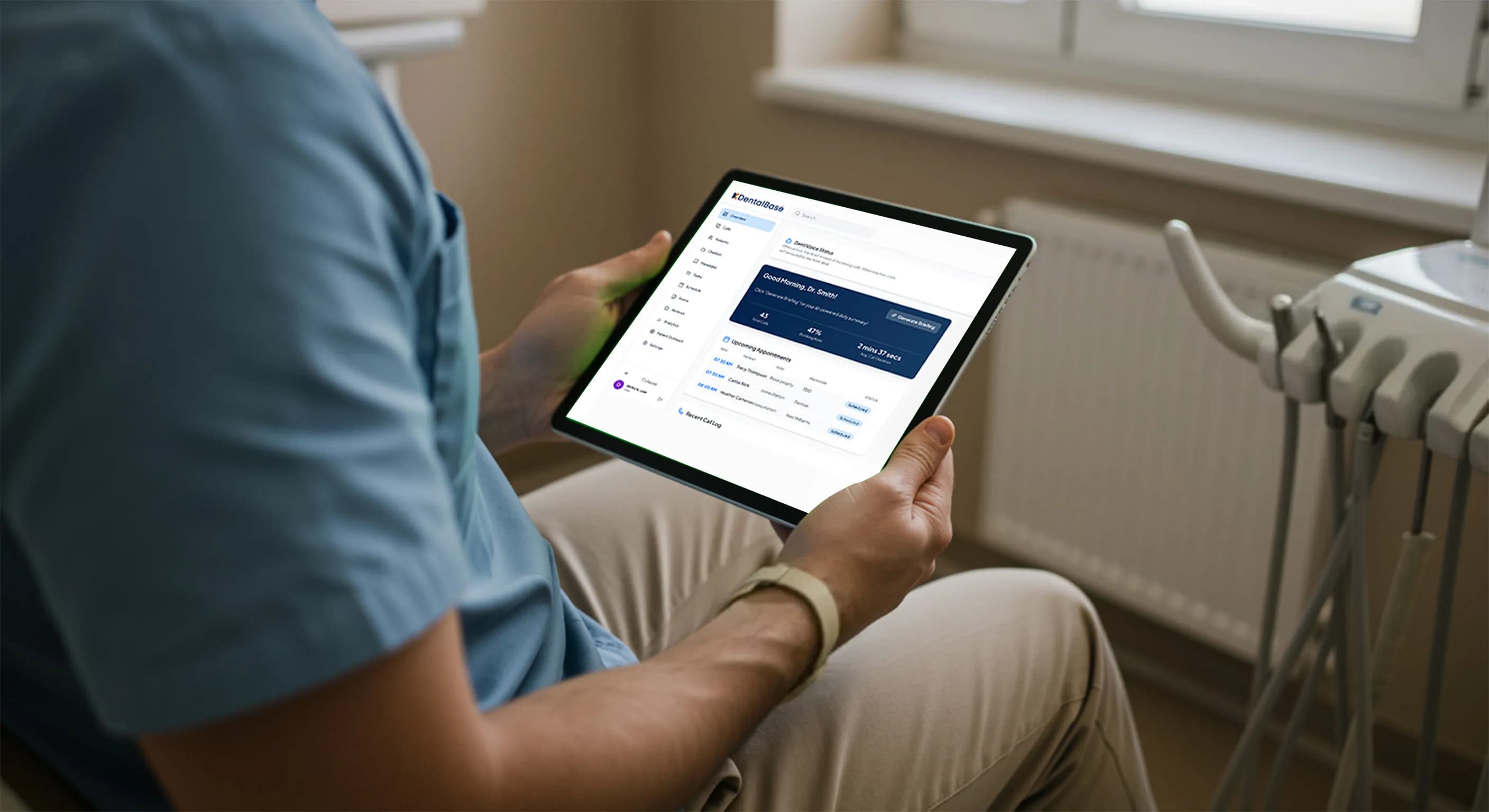
Evaluating an AI Receptionist for Dental HIPAA Compliance

Evaluating an AI receptionist for dental HIPAA compliance: what to ask vendors, which red flags are deal-breakers, and how often to reassess.
Share:
Table of contents
A single missed safeguard can cost a dental practice far more than money. According to IBM's 2023 Cost of a Data Breach Report, healthcare had the highest average breach cost of any industry at $10.93 million. Dental practices are not exempt, especially as AI tools increasingly answer phones, schedule appointments, and follow up with patients after hours. Many of these tools interact directly with protected health information (PHI), which makes evaluating an AI receptionist for dental HIPAA compliance a business-critical responsibility, not an IT side project.
Dental practice owners often adopt AI to reduce front desk overload, capture after-hours calls, and improve patient responsiveness. The operational upside is real, but so is the compliance risk. An AI receptionist may store call recordings, analyze conversations, or integrate with practice management systems. If those processes are not aligned with HIPAA regulations, your practice carries the liability.
This how-to guide walks you through the process with a clear, step-by-step framework tailored to real dental workflows. It focuses on vendor due diligence and ongoing oversight rather than the basics; if you are new to the topic, start with the dentist guide to AI receptionist HIPAA compliance. You will learn what documentation to demand, how to spot red flags early, and how to manage compliance after onboarding.
Why Does HIPAA Compliance Matter When Using AI in Dentistry?
HIPAA compliance has always been part of running a dental practice, but AI in dentistry changes the risk profile in meaningful ways. Traditional compliance focused on staff behavior and internal systems. AI receptionists add a third-party layer that processes PHI outside your direct control.
How Does Compliance Affect Daily Practice Operations?
When an AI tool mishandles PHI, the impact shows up as front desk disruption, meetings with legal counsel, and lost hours during audits. Vetting the vendor at the outset helps practices avoid those hidden costs.
How Does AI Expand HIPAA Risk for Dental Practices?
AI tools used by dental practices often handle:
- Call recordings that include patient names, symptoms, and insurance details
- Appointment data synced with practice management systems
- Automated follow-up messages containing treatment references
Third-party vendors sit outside your direct control, so a gap in their safeguards becomes a gap in yours. When an AI receptionist lacks proper safeguards, even routine interactions can trigger violations. The California Dental Association publishes a useful overview of the HIPAA violation risks that AI tools create in dentistry.
What Is the Financial and Operational Impact of a HIPAA Violation?
HIPAA civil penalties are tiered by level of culpability and adjusted for inflation each year, and for the most serious violations they can reach into the millions of dollars in a single year under 45 CFR 160.404. Beyond fines, practices face:
- Mandatory breach notifications to patients
- Reputational damage that reduces patient retention
- Operational downtime during investigations
Vetting the vendor before a contract is signed helps you prevent these outcomes.
Does HIPAA Apply to AI Chatbots as Well as Phone-Based AI Receptionist?
Yes, HIPAA applies to any AI tool that creates, receives, stores, or transmits PHI, regardless of whether patients interact by voice or text. A chat widget that collects a patient’s name, symptoms, or insurance details carries the same compliance obligations as a phone-based AI Receptionist.

Do Chat Tools Carry Less Risk Than Voice Calls?
Dental practices sometimes assume chat-based tools carry less risk because no audio recording exists. This is a mistaken assumption. Written PHI is still PHI, and a chatbot transcript log can expose the same categories of data as a call recording. Any vendor offering both voice and chat channels needs a single BAA that explicitly covers every channel it uses to touch patient information. Customized voice scripts raise similar questions, which a structured evaluation of AI receptionist customization walks through alongside the other vendor checks.
Does an Existing BAA Cover a New Chat Widget?
Practices that add a website chat widget after already onboarding a phone-based AI Receptionist should treat it as a separate compliance touchpoint, not an extension covered automatically by the original agreement. Confirm in writing that the existing BAA names the chat feature specifically, and ask whether chat transcripts are stored in the same encrypted system as call recordings or in a separate, less-audited database.
What Counts as PHI in a Chat Transcript?
Any detail that identifies the patient or connects them to care counts, including names, phone numbers, email addresses, insurance identifiers, appointment history, and described symptoms. Free-text fields are the usual gap, because patients often volunteer more than the form asked for.
Online paperwork is a common place for these details to pile up, so it helps to see how AI dental intake forms fit into a HIPAA review alongside your phone and chat tools.
What HIPAA Regulations Apply to AI Receptionist?
Not every AI vendor understands their role under HIPAA regulations, which makes it essential for dental practices to know the rules themselves. HIPAA applies to AI Receptionist when they create, receive, maintain, or transmit PHI on your behalf.
For how these requirements surface in day-to-day call handling and messaging, see HIPAA-compliant dental communication with AI.
HIPAA is one half of the vendor question. If the platform will also place automated calls or texts, ask how it handles consent and opt-out obligations under the TCPA, because that liability sits with your practice rather than the vendor.
How Do Regulators Typically Interpret These Rules?
Regulators tend to ask whether the practice performed reasonable due diligence before sharing PHI. Document why you chose the vendor, what safeguards you reviewed, and how you weighed the risks; notes from vendor calls and copies of security summaries help if questions arise later.
What Is the Difference Between the HIPAA Privacy Rule and Security Rule?
The Privacy Rule controls how PHI may be used and disclosed, while the Security Rule sets the technical, physical, and administrative safeguards that protect that data. An AI Receptionist can violate one without violating the other, so both must be reviewed separately during evaluation.
| HIPAA Rule | What It Governs | What AI Receptionist Must Do |
|---|---|---|
| Privacy Rule | How PHI can be used, shared, or disclosed | Limit PHI use to agreed purposes and restrict access to authorized staff |
| Security Rule | Administrative, physical, and technical safeguards | Encrypt data, apply role-based access, and maintain audit logs |
| Breach Notification Rule | How and when a breach must be reported | Notify the practice without unreasonable delay and no later than 60 days after discovery; a BAA can require sooner |
Reviewing both rules side by side helps dental practices ask sharper vendor questions. A vendor may have strong encryption, satisfying the Security Rule, while still repurposing conversation data for unrelated AI training, which violates the Privacy Rule. Check both columns, not just one.
What Are a Business Associate’s Obligations Under HIPAA?
Any AI vendor handling PHI is a Business Associate. Confirm that they understand and accept this role contractually and operationally.
How Does a HIPAA-Compliant AI Receptionist Compare to a Non-Compliant One?
A HIPAA-compliant AI Receptionist signs a BAA, encrypts PHI, restricts training-data use, and documents retention limits, while a non-compliant one is vague, evasive, or silent on these same points. Comparing vendors side by side on identical criteria makes the gap easy to see.
This table is a snapshot of the same larger framework covered in the full HIPAA compliance guide for AI receptionists, which walks through each of these criteria in more depth.
| Criterion | HIPAA-Compliant Vendor | Non-Compliant Vendor |
|---|---|---|
| Business Associate Agreement | Signs a BAA before onboarding and updates it as services change | Refuses, delays, or offers only a generic terms-of-service link |
| Data encryption | Encrypts PHI in transit and at rest | Cannot confirm encryption standards in writing |
| Training data use | PHI excluded from model training without explicit authorization | Vague or evasive about whether call data trains AI models |
| Access controls | Role-based permissions and individual staff logins | Shared logins with no activity audit trail |
| Breach notification | Contractual notification timeline stated in days, well inside the 60-day legal limit | No defined timeline or notification process |
| Data retention | Published retention limits with documented deletion process | Indefinite storage with no stated deletion policy |
Use this table as a working scorecard during vendor calls. Ask each vendor to answer every row in writing rather than verbally, since written answers are what actually hold up if a compliance question arises later. A vendor that hedges on more than one row deserves closer scrutiny before any contract is signed.
What if a Vendor Falls Between the Two Columns?
Most vendors will. Treat partial answers as open items rather than passes, put each one in writing with an owner and a date, and decide whether the gaps are contractual or technical before moving forward.
What Does Evaluating an AI Receptionist for Dental HIPAA Compliance Involve, Step by Step?
Evaluate an AI receptionist for HIPAA compliance in three steps: confirm the vendor will sign a Business Associate Agreement, verify how it handles and stores patient data, and request documentation of its security controls. Each step below shows what to ask and which answers should end the evaluation.

If your evaluation includes AI phone assistants or virtual receptionists, it can be helpful to compare how different systems handle calls from intake through booking. Resources that break down dental call handling AI from call to booking provide useful context when assessing whether a vendor’s workflows align with your compliance expectations.
What Should You Gather Before You Start?
Before you start, identify which workflows the AI will touch, such as after-hours call handling, scheduling, or patient follow-ups. Mapping those touchpoints shows which types of PHI are involved and whether a vendor\'s safeguards fit. This preparation makes the evaluation more efficient and less reactive.
Step 1: Will the Vendor Sign a Business Associate Agreement (BAA)?
Start with the BAA. If an AI vendor will not sign a BAA, stop the evaluation. At minimum, the agreement should:
- Define permitted uses of PHI
- Outline data disposal responsibilities
- Require breach notification timelines
For a clause-by-clause breakdown, including subprocessor disclosure and what happens to recordings when the contract ends, see the guide to business associate agreements for AI receptionists.
Step 2: How Does the Vendor Handle and Store Patient Data?
Ask direct questions:
- Where is patient data stored?
- How long are call recordings retained?
- Is data used to train AI models?
Unclear retention terms let stored PHI outlive its purpose, so get a written retention period before you sign.
Step 3: What Security Controls Does the Vendor Have in Place?
Request documentation on:
- Encryption standards
- Access control methods
- Incident response plans
Ask for the documents rather than trusting assurances. The NIST guide to implementing the HIPAA Security Rule is a useful checklist for what to request. A SOC 2 report can support the answers but does not replace HIPAA obligations; this SOC 2 guide for dental practices explains the difference.
How Should Staff Be Trained to Handle AI Receptionist Compliance Incidents?
Staff should be trained to recognize what counts as PHI within AI Receptionist workflows and know the exact escalation path if something looks wrong. A written incident response plan, reviewed with the vendor, closes the gap between signing a BAA and actually operating compliantly day to day.
What Should You Ask the Vendor About Breach Notification?
Ask the vendor how quickly they notify your practice after a suspected incident, who on their side owns that communication, and what information they will provide during an internal investigation. Practices that pair vendor training resources with their own front-desk protocols, such as the guidance in training an AI dental receptionist on practice FAQs, tend to close this loop faster than practices that treat vendor onboarding and staff training as separate projects. Under the Breach Notification Rule, a business associate must notify the practice without unreasonable delay and no later than 60 days after discovering a breach.
What Should an Internal Training Session Cover?
A short internal training session should cover three things: how to identify PHI inside AI Receptionist transcripts and call logs, how to report a suspected compliance issue without waiting for a scheduled meeting, and who is authorized to speak with the vendor about a live incident. Revisiting this training whenever the vendor rolls out a new feature keeps staff current without turning compliance into a full-time job.
Who Should Own AI Receptionist Compliance on Your Team?
Name one person, usually the office manager or privacy officer, as the single point of contact for the vendor. Shared ownership sounds collaborative but tends to mean nobody escalates quickly when a transcript looks wrong on a busy Monday.
What Belongs in a Written Incident Response Plan?
At minimum: what triggers a report, who staff notify first, how the vendor is contacted after hours, what gets documented while the issue is live, and who signs off that the matter is closed.
What Are the Key Red Flags to Watch for During AI Vendor Assessment?
The main red flags in an AI receptionist vendor are a refusal to sign a BAA, vague answers about training data, weak access controls, and no clear retention policy. Each signals a compliance gap that lands on your practice rather than the vendor if it goes unaddressed.
Red Flag 1: What if the Vendor Refuses to Sign a BAA?
A vendor that will not sign a BAA should not be handling PHI for you at all. Without one, liability stays with your practice.
Red Flag 2: What if the Vendor Gives Vague Answers About AI Training Data?
If a vendor cannot clearly explain whether patient interactions are used for model training, assume elevated risk. HIPAA compliance requires explicit limits on secondary data use.
Red Flag 3: What if the Vendor Has Limited Access Controls?
Shared logins or lack of role-based permissions indicate weak security posture. Without individual logins there is no audit trail showing who viewed which patient record.
Red Flag 4: What if There Is No Clear Data Deletion or Retention Policy?
An AI receptionist that cannot state how long it keeps call recordings or transcripts, or how it deletes them on request, creates open-ended liability for your practice. Every vendor contract should include a specific retention period and a documented deletion process, not an open-ended promise to “handle it responsibly.”
Which Red Flags Are Immediate Deal-Breakers vs Just Cautionary?
A refusal to sign a BAA or vague answers about AI training data are deal-breakers because they leave your practice with no contractual protection at all. Limited access controls and unclear retention policies are serious but often fixable if the vendor commits to a written remediation timeline.
| Red Flag | Severity | Recommended Action |
|---|---|---|
| Refusal to sign a BAA | Deal-breaker | End the evaluation immediately |
| Vague answers about AI training data | Deal-breaker | Request written clarification; reject if unresolved |
| Limited access controls | Serious, often fixable | Request a remediation timeline before signing |
| No clear data deletion or retention policy | Serious, often fixable | Require a written retention limit in the BAA |
Be willing to walk away when a deal-breaker appears.
How Should You Document a Deal-Breaker Decision?
Write a short file note recording the date, who you spoke with, the exact question asked, and the answer given. That record shows a reasoned selection process if the practice is later asked how it vetted a vendor.
What Does an Acceptable Remediation Timeline Look Like?
A specific commitment with a named owner and a calendar date, confirmed in writing. Open-ended answers about items being on the roadmap are not timelines, and they rarely improve once a contract is signed.
Evaluating an AI receptionist for dental HIPAA compliance is no longer optional for dental practices adopting AI-driven communication tools. Three takeaways matter most. First, any AI vendor handling PHI must meet clear HIPAA obligations and sign a BAA. Second, structured evaluation of data handling, security controls, and policies reduces compliance risk significantly. Third, ongoing oversight after onboarding is just as important as initial vetting.
How Often Should You Reassess an AI Receptionist Vendor After Onboarding?
Dental practices should audit AI Receptionist at least annually, with lighter quarterly spot-checks and an immediate review triggered by any major system update, security incident, or change in vendor ownership. Compliance is not a one-time gate; vendor practices and product features change over time.
| Review Type | Frequency | What to Check |
|---|---|---|
| Initial audit | At onboarding | BAA terms, encryption confirmation, access control setup |
| Spot-check review | Quarterly | Call quality, escalation accuracy, any new features enabled |
| Full compliance audit | Annually | Retention practices, training data use, updated security documentation |
| Trigger-based review | After any major update, breach, or ownership change | Whatever changed, plus a re-confirmation of the BAA |
How Do You Fold Compliance Into Existing Reviews?
Pairing compliance reviews with routine operational checks makes this easier to sustain. Practices already tracking AI receptionist call quality or following a structured approach to operating an AI voice receptionist can fold a short compliance checklist into the same review cycle instead of running it as a separate project.
How Do You Keep an Audit Trail Between Reviews?
Keep one dated folder per vendor holding the signed BAA, security documentation, review notes, and any incident records. When the annual audit comes around, the work is mostly reading rather than reconstructing.
Ready to Evaluate an AI Receptionist for Your Practice?
For practice owners and office managers, the next step is practical: select one current or prospective AI vendor and walk through this framework line by line, documenting where answers are clear and where gaps remain.
What Is the Fastest Way to Start?
Even a short internal checklist completed in under an hour can surface meaningful risks.
To see how a compliance-focused AI assistant aligns with real dental workflows, you can explore DentiVoice using the same criteria outlined in this guide.
Compliance is one piece of a larger evaluation. See the full vendor checklist covering conversation quality, scheduling integration, and after-hours coverage alongside compliance. For a narrower, practice-specific framing of that same decision, this breakdown of how to pick the right AI receptionist for your dental office walks through it step by step.
For a side-by-side look at how that compliance posture compares to a human-operated service, see the full HIPAA and cost comparison between AI and traditional answering services.
Request a DentiVoice demo to see how it would work in your practice.
Frequently Asked Questions
The key factors include whether the vendor will sign a Business Associate Agreement, how they store and use patient data, and what security safeguards they have in place. Clear documentation and transparency are essential. These elements form the foundation of effective AI vendor assessment.
Dental practices can ensure compliance by running a formal vendor evaluation, requiring a signed BAA, reviewing security controls in writing, and scheduling regular audits. Ongoing oversight matters because vendor practices, subprocessors, and product features change over time, and each change can reopen a gap in patient data protection.
Common violations include storing unencrypted call recordings, using patient data for AI training without authorization, and working with vendors that refuse to sign BAAs. These issues frequently appear in dental technology compliance reviews.
A BAA legally defines the vendor’s responsibility to protect PHI and sets out breach notification requirements, permitted uses, and data return or disposal terms. Without one, the dental practice assumes most of the compliance liability, because HIPAA does not allow PHI to be shared with a vendor that lacks satisfactory written assurances.
At a minimum, audit AI vendors annually, with lighter quarterly spot-checks in between. Add an immediate review after any major system update, security incident, change in vendor ownership or subprocessors, or change in where patient data is stored, since each can invalidate the assumptions behind your last review.
Yes, if the system records calls or accesses patient information, HIPAA regulations apply. Any AI tool that creates, receives, maintains, or transmits PHI on your behalf must meet compliance requirements, and the practice needs a signed BAA with the vendor before patient data flows through it.
No, vendor claims should always be verified through documentation and contractual agreements. Ask for the signed BAA, written security answers, and retention terms rather than accepting a marketing page or a verbal assurance, because only written evidence holds up if a compliance question arises later.
Staff training helps ensure AI tools are used appropriately and that potential privacy issues are identified early. Staff who can recognize PHI in transcripts and call logs, and who know exactly whom to notify, catch problems sooner, and human error remains a common contributor to compliance failures.
Yes. HIPAA applies to any AI tool that creates, receives, stores, or transmits PHI, whether patients interact by voice or text. A chat-based tool carries the same compliance obligations as a phone-based AI Receptionist, including a BAA that names the chat channel specifically.
The Privacy Rule governs how PHI can be used and disclosed, while the Security Rule sets the encryption, access control, and audit-log safeguards that protect it. AI Receptionist must satisfy both rules, and a vendor can pass one review while failing the other.
There is no single legal number, but every BAA should state a specific retention period and a documented deletion process. Open-ended or unstated retention terms are themselves a compliance red flag worth raising directly during vendor evaluation calls.
Yes. Most practices manage this internally by combining vendor-provided training materials with a written incident response plan and a designated compliance point of contact. A consultant is optional, not required, for most standard AI Receptionist evaluations.
Yes. Each new vendor is a separate Business Associate with its own BAA, security practices, and data handling policies. Treat a vendor switch as a full evaluation using the same framework, not as a simple technical migration.
Sources & References
- 1AI in dentistry: What are the HIPAA violation risks?
Published by the California Dental Association, providing authoritative insights on HIPAA compliance in dental AI applications.
- 2IBM Cost of a Data Breach Report
Annual industry benchmark for breach costs, including healthcare.
- 345 CFR 160.404: Amount of a civil money penalty
Official federal regulation text on HIPAA civil penalty tiers.
- 445 CFR 164.410: Notification by a business associate
Official federal regulation text on business associate breach notification.
- 5NIST SP 800-66 Rev. 2: Implementing the HIPAA Security Rule
U.S. NIST guidance on implementing the HIPAA Security Rule.
- 645 CFR 164.504: Uses and disclosures, organizational requirements
Official federal regulation text on business associate contract requirements.
Topics
Was this article helpful?
Written by
DentalBase Team
Expert dental industry content from the DentalBase team. We provide insights on practice management, marketing, compliance, and growth strategies for dental professionals.