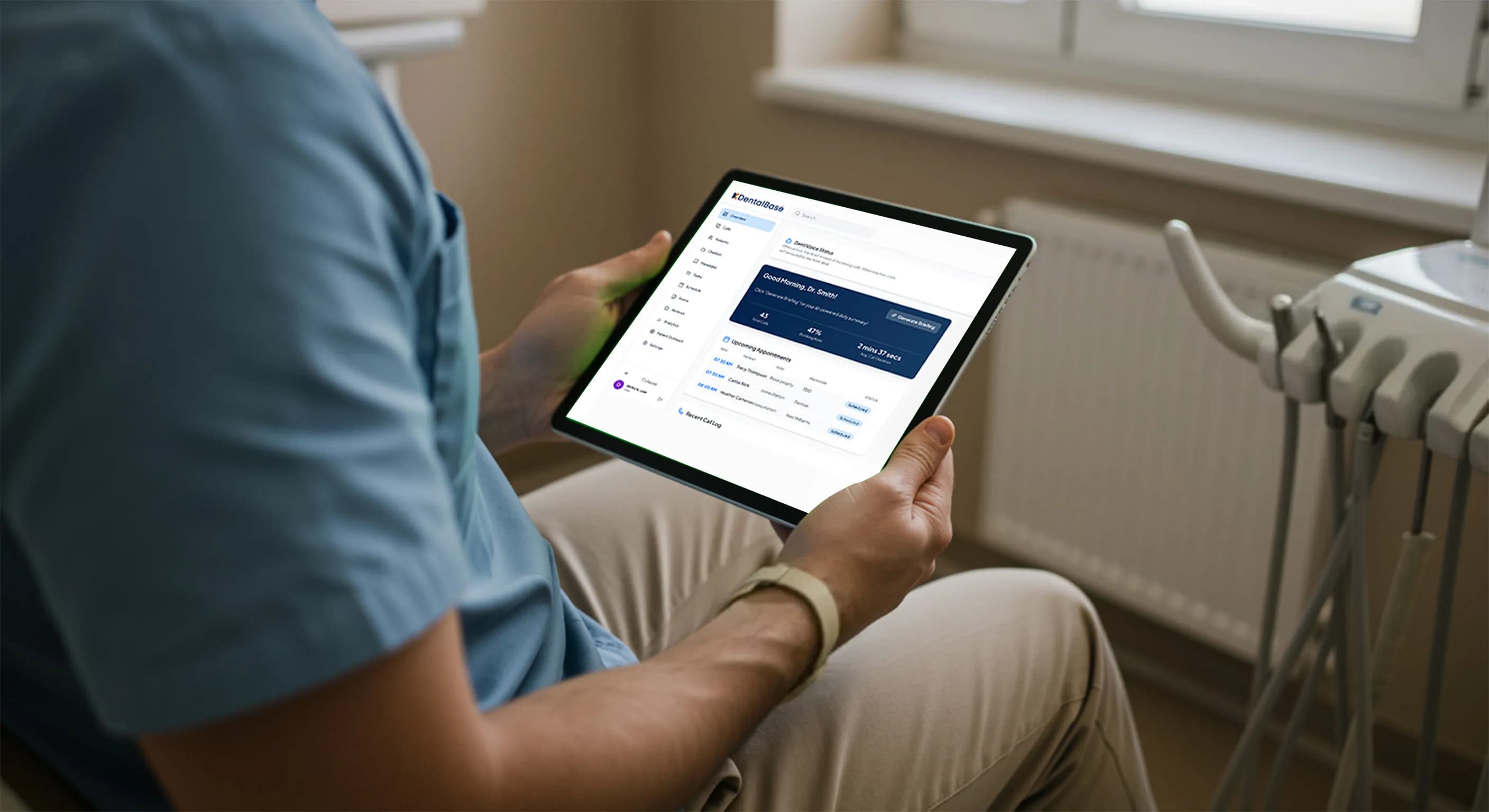
Dental Call Handling AI Explained From Call to Booking

How dental call handling AI answers, understands, and books patient calls, from the first ring to a confirmed appointment inside your dental software.
Share:
Table of contents
Dental practices lose a surprising number of new patients before they ever step into the clinic. Missed calls, long hold times, and inconsistent call handling all create friction. This is where dental call handling AI changes the game, automating patient conversations while preserving a natural, human-like experience.
In this guide, we explain how call handling AI works step by step, from the moment a patient calls to the final appointment booking.
Booking is the step most practices want to automate first. If that is where you are starting, this step-by-step plan for automating dental appointment scheduling covers the rollout from software selection to go-live.
Related: If your phones never seem to stop, the underlying problem is usually capacity, not effort. See why your dental office phone is always busy and how to fix it →
What Is Dental Call Handling AI?
Call handling AI for dentistry is voice software that answers your practice phone, understands what the caller wants, and finishes the task on the call. It books, reschedules, answers insurance questions, and flags emergencies, then writes the result into your practice management system without staff retyping anything.
Dental call handling AI is a voice-based artificial intelligence system designed specifically for dental practices. It answers incoming calls, understands patient intent, responds conversationally, and completes tasks such as:
-
Booking and rescheduling appointments
-
Answering common dental questions
-
Capturing new patient information
-
Routing urgent calls appropriately
Unlike basic IVR systems, modern AI uses natural language processing (NLP) to understand real patient speech, not keypad inputs.
Underneath, five parts do the work together. Knowing them helps when you compare vendors, because a demo that sounds polished can still be weak on the part that matters most to you: writing a real appointment into your software.
Speech recognition
Turns the caller's words into text in real time, accents and background noise included.
Intent detection
Decides why the person called: booking, insurance, billing, or an emergency.
Dialogue manager
Holds the thread of the conversation, asks follow-ups, and knows when to hand off.
Voice synthesis
Speaks back in a calm, natural voice instead of a recorded phone menu.
PMS integration
Reads the live schedule and writes the confirmed appointment into the patient record.
The distinction worth holding onto is between answering and completing. A tool that answers gives the caller a voice. A tool that completes gives the caller an appointment. Only the second one changes your schedule. That difference shows up in text based tools too, which is covered in voice AI versus text AI for dental receptionists →
How Does Dental Call Handling AI Work, Step by Step?
Call handling AI works in five stages: it answers the ring, detects intent, holds a natural conversation, checks live schedule availability, then confirms and logs the booking. Each stage passes clean data forward, so a caller reaches a real outcome instead of a message pad.
1. Incoming Call Is Instantly Answered
When a patient calls your practice, the AI answers immediately, no hold music, no missed calls.
Why this matters:
-
Patients are more likely to book when calls are answered within the first few seconds
-
After-hours calls are handled 24/7
2. AI Identifies Patient Intent
Using conversational AI, the system listens and determines why the patient is calling. Common intents include:
-
“I want to book an appointment”
-
“Do you accept my insurance?”
-
“I have a dental emergency”
The AI doesn’t rely on scripts, it understands natural conversation flow.
3. Contextual Conversation Begins
The AI responds with relevant, friendly dialogue, adapting to the patient’s tone and needs.
For example:
-
New patients are guided through onboarding questions
-
Returning patients are recognized and assisted faster
-
Emergency callers are prioritized and escalated
This creates a front-desk-quality experience, without overloading staff.
4. Real-Time Appointment Availability Check
Once booking intent is confirmed, the AI securely connects to the practice management system to:
-
Check real-time availability
-
Offer suitable appointment slots
-
Confirm provider preferences
Patients can book without waiting for a human receptionist.
5. Appointment Confirmation and Data Capture
Before ending the call, the AI:
-
Confirms date and time
-
Collects contact details
-
Sends SMS or email confirmations automatically
All information is logged accurately, no manual entry, no errors.
What Does the Full Call-to-Booking Journey Look Like?
The full journey moves through five quick stages, from the first ring to a confirmed appointment in your schedule. Each stage hands clean data to the next, so nothing gets retyped and nothing slips. Here is the path a typical patient call takes.
Answer
Call picked up on the first ring, day or night.
Understand
AI reads intent: booking, billing, or emergency.
Converse
Natural back-and-forth gathers what the visit needs.
Check & Book
Live schedule lookup offers real open slots.
Confirm
Details logged, SMS or email sent automatically.
Notice what is missing from that flow: hold music, voicemail, and the callback that never happens. A returning patient who wants a Tuesday cleaning can be booked in under five minutes, while a caller with a cracked molar gets flagged and routed first. The point is not speed for its own sake. It is that every caller reaches a real outcome on the first try. Learn how AI triages urgent calls versus routine ones →
See it handle a real call
DentiVoice answers, books, and confirms inside your existing dental software, so the front desk keeps its focus on patients in the chair.
Explore AI dental reception →Why Do Dental Practices Use Call Handling AI?
Practices adopt call handling AI because the phone is where new patient revenue leaks fastest. It answers every call at peak times, lunch, and after hours, keeps the greeting consistent across locations, and takes routine scheduling work off a front desk that is already stretched thin.
Dental call handling AI delivers measurable operational and revenue benefits:
-
Higher call answer rates (even after hours)
-
More booked appointments from inbound calls
-
Reduced front-desk workload
-
Consistent patient experience across every call
For multi-location or high-volume clinics, AI becomes a scalable front-desk extension.
Staffing pressure is the other half of the story. The American Dental Association Health Policy Institute tracks how hard practices find it to recruit and keep administrative staff, and front desk roles are among the hardest to fill. When one person is out, the phone is usually the first thing to break.
So the value is not only extra bookings. It is stability. The greeting sounds the same on a Tuesday morning with a full team and on the Friday when two people call out sick.
Which Dental Calls Can AI Handle Without Your Front Desk?
Voice AI handles the repeatable calls end to end: new patient booking, rescheduling, confirmations, basic insurance questions, and after hours coverage. It screens emergencies and routes them by your rules. Judgment calls like billing disputes and clinical questions still belong with your team.
| Call type | What the AI does | Human handoff? |
|---|---|---|
| New patient booking | Collects name, reason for visit, insurance, and books a real open slot | Rarely, unless the case is complex |
| Existing patient reschedule | Finds the current appointment and moves it inside the schedule | No |
| Insurance and coverage | Answers plan participation questions from your configured rules | Yes, for benefit specifics and claims |
| Dental emergency | Screens symptoms, applies your triage rules, escalates by priority | Yes, immediately |
| Billing dispute | Captures the account detail and logs a callback task | Yes, always |
| After hours voicemail replacement | Books or texts back instead of leaving a message | Next business day if needed |
Insurance is the line most owners underestimate. The AI can confirm whether you take a plan and capture the subscriber details, but real time benefit checks depend on what your clearinghouse integration supports → Set that expectation before go live, not after the first frustrated caller.
Calls that come in when nobody can pick up are the easiest win. Instead of voicemail, the system either books the caller or sends an instant text so the conversation stays alive. That pattern is explained in missed call text back for dental practices →
Emergency calls are the exception worth scripting carefully. What the caller hears in the first ten seconds shapes whether they stay on the line, and dental emergency call handling covers what patients need to hear →
What Happens to the Calls Your Practice Misses Today?
Missed calls rarely call back. A patient who reaches voicemail at lunch or after hours usually moves on to the next office on their search results. The call you never answered becomes a new patient for a competitor. That is the quiet leak most practices never measure.
The Weekly Math on Missed Calls
Think about the math on a normal week. A three-provider practice taking 200 calls a week might miss 30 to 50 of them across lunch breaks, busy mornings, and evenings. Even at a modest booking rate, that is several new patients walking away every month. Over a year, the lost production adds up fast.
- 200 calls/week is a typical volume for a three-provider practice
- 30 to 50 of those calls go unanswered across lunch, mornings, and evenings
- Even a modest booking rate turns that gap into several lost new patients every month
- Compounded over a year, the lost production adds up to a meaningful revenue leak
These Aren’t Bad Leads
The frustrating part is that these are not bad leads. They are people who already chose to pick up the phone and call you. They had intent. The only thing standing between them and a booked visit was an available answer. That is the exact gap call handling AI is built to close.
The Hidden Staffing Cost
There is a staffing cost too. When the phone rings nonstop, your front desk either ignores the patient at the counter or lets calls slide. Neither is good. Constant phone pressure is also a leading driver of front office turnover, which creates its own expensive cycle. See how to reduce dental front office burnout →
The takeaway: a missed call is not neutral. It is a patient who was ready to book, lost to whoever answered first.
Putting a dollar figure on that leak changes the conversation with your team. See how much missed calls cost and how AI recovers that revenue →
How Is AI Call Handling Different From an IVR or Answering Service?
AI call handling understands natural speech and books appointments on its own, while older tools mostly route, record, or take a message. An IVR makes callers press numbers. An answering service takes notes a human transcribes later. AI does the work on the call itself. The table below shows where each option lands.
| Capability | IVR / Answering Service | Call Handling AI |
|---|---|---|
| Understands plain speech | No, menu or human only | Yes, natural language |
| Books appointments live | Rarely, takes a message | Yes, checks real openings |
| Works after hours | Voicemail or call center | Yes, 24/7 coverage |
| Routes emergencies | Manual or delayed | Flags and escalates instantly |
| Logs data into your PMS | Manual re-entry | Automatic, no retyping |
The practical takeaway is simple. An answering service protects you from a fully missed call, but the booking still waits on a human callback the next morning. By then, many callers have already booked elsewhere. AI closes that gap by finishing the task while the patient is still on the line. For a deeper breakdown of why messages alone leak patients, read why dental voicemail loses patients →
Related: Curious which calls actually come in and how often each type shows up? See the top 10 dental call types patients ask about →
Is Dental Call Handling AI Secure and Compliant?
Yes, when the vendor is set up correctly. Any platform that hears or stores patient information is a business associate under HIPAA, so it needs a signed agreement, encryption in transit and at rest, access controls, and audit logging. Compliance is a vendor selection question, not a feature checkbox.
Yes, enterprise-grade dental AI platforms are built with:
-
Encrypted call data
-
HIPAA-aligned workflows
-
Secure integrations with dental software
Patient privacy and compliance remain fully protected.
Those bullets are the marketing version. The legal version is more specific. Under the HIPAA Security Rule, published by the U.S. Department of Health and Human Services, a vendor handling protected health information on your behalf is a business associate and must apply administrative, physical, and technical safeguards. That relationship is documented in a Business Associate Agreement.
Two numbers are worth writing down. The Security Rule sets out 3 categories of required safeguards under 45 CFR Part 164, and the HIPAA Breach Notification Rule gives covered entities up to 60 days to notify affected individuals after a breach is discovered. Your vendor contract should name both.
Get the agreement signed first. Not after the pilot.
Compliance checklist before you go live
Check each item your vendor can evidence in writing.
Any unchecked box is a question for your vendor, not a detail to sort out later.
Recording consent deserves its own look. Around 11 states, including California, Florida, Illinois, Massachusetts, Pennsylvania, and Washington, require all parties to consent before a call is recorded, which shapes the disclosure your AI reads at the start of a call. The state by state detail sits in call recording laws for dental practices →
Ask for evidence rather than assurances. An independent audit report tells you far more than a compliance badge on a website, and the difference between the two is covered in the SOC 2 guide for dental AI receptionists →
If you are starting from the compliance basics rather than vendor audit reports, this HIPAA compliance guide for AI dental receptionists → walks through what applies to your practice.
How Does Call Handling AI Connect to Your Dental Software?
The Two-Way Integration Link
Call handling AI connects to your practice management system through a secure integration that reads your live schedule and writes confirmed bookings back in real time. That two-way link is what separates a tool that talks from a tool that actually books. Without it, the AI is just a smarter voicemail.
Most platforms support common dental systems out of the box. The AI checks open slots by provider and operatory, then writes the appointment, patient details, and notes directly into the record. No double entry. No sticky notes for the morning huddle.
Integration depth varies by system. Open systems with documented APIs, such as Open Dental, generally allow deeper write access than closed platforms, which affects whether the AI can book directly or only propose times. Ask the vendor which systems they write to today, not which ones are on a roadmap.
Closed systems work differently. If you run Dentrix, the write path and its limits are mapped out in how Dentrix works with an AI dental receptionist →
Online booking widgets and phone calls should also share one schedule. Two systems writing separately is how double bookings start, and the online booking integration guide → explains how the two channels stay in sync. Caller recognition helps too, since knowing who is calling before the greeting shortens the whole conversation, as covered in caller ID screen pop and call context →
What a Typical Setup Looks Like
Setup is lighter than most owners expect. A typical rollout maps your providers, hours, and appointment types, then runs a short test period before going live on the main line. Staff training is minimal because the AI handles the call, not the team. If you run Open Dental, see exactly how the Open Dental integration works →
- Map providers, hours, and appointment types into the system
- Run a short test period before going live on the main line
- Keep staff training minimal since the AI handles the call, not the team
Does It Actually Book, or Just Suggest Times?
One question owners ask early: can the AI really write into the software, or does it just suggest times? With a true integration, it books. For the full answer, see whether an AI receptionist can book appointments in dental software →
Is your practice ready for call handling AI?
Check each item that sounds like your front desk today.
Three or more checks usually means missed calls are quietly costing you new patients.
Related: If those signs sound familiar, your team may already be past capacity. Spot the 7 signs of an overwhelmed dental front desk →
Which Metrics Show Your Call Handling AI Is Working?
Track six numbers: call answer rate, booking conversion, after hours capture, escalation rate, time to first response, and source attribution. Record a two week baseline before go live. Without that baseline you cannot tell improvement from seasonality, and every later review turns into an argument about anecdotes.
Call answer rate
Share of inbound calls answered live, including lunch and after hours
Booking conversion
Percentage of answered calls that end with a confirmed appointment
After hours capture
Appointments booked outside your posted office hours
Escalation rate
How often the AI hands a call to a person, and why
Time to first response
Seconds before a caller hears a voice instead of ringing
Source attribution
Which ad, listing, or referral produced the booked call
- Pull four weeks of call logs from your phone system and count answered versus abandoned calls by hour.
- Mark the two worst hours of your week. Those are almost always lunch and the first hour after opening.
- Count how many answered calls actually became appointments, not just conversations.
- Re-measure the same six numbers thirty days after go live, using the same hours and the same definitions.
One practical benchmark: measure the same 6 metrics across 4 full weeks before go live, then across 4 full weeks after. Anything shorter measures seasonality, not system performance.
Escalation rate is the one people misread. A high rate is not failure. It means the AI is passing the right calls to a person, which is exactly what you want on a billing dispute or an anxious caller. Watch the trend, not the number.
Attribution closes the loop between marketing spend and booked chairs, which most practices still guess at. The mechanics are in dental marketing attribution and call tracking → Payback timing depends on your call volume and average new patient value, and the ROI payback breakdown → walks through the math with real inputs.
What Should You Ask Before Choosing a Dental AI Vendor?
Ask about integration depth, escalation rules, voice and script control, security evidence, and what happens when the AI gets something wrong. Demos are built to sound good. These questions test whether the system holds up on a Monday morning with a full schedule and an anxious caller.
- Does it write into my system, or only read? Ask to watch an appointment appear in a live schedule during the demo.
- Who controls the script? You should be able to change how the AI answers common questions without a support ticket.
- How does it handle an emergency at 11pm? Get the exact escalation path in writing.
- What does the caller hear when it fails? A graceful handoff beats a dead end every time.
- Can I hear real recordings? Not a scripted highlight reel.
- What security evidence can you share? Audit reports, not badges.
Voice matters more than owners expect. A practice serving retirees needs a different pace than one booking cosmetic consults, and the voice customization evaluation guide → covers what to listen for. Script control is the companion question, explained in AI receptionist script customization →
Watch for this: vendor case studies that report booked calls without reporting kept appointments. The two numbers are not the same, and the gap between them is where inflated claims live.
Treat published results the way you would treat a lab report with no methodology. The checklist in how to verify vendor ROI claims → shows which questions expose a soft number, and the 2026 cost guide → explains what actually drives pricing.
For a wider view of the market before you shortlist, this guide to choosing dental AI receptionist software → lays out the selection criteria side by side.
Where Does Call Handling AI Still Need Your Team?
AI supports the front desk, it does not stand in for clinical judgment or difficult human moments. Treatment questions, billing disputes, upset patients, and anything requiring a clinician belong with your team. The system earns trust by knowing when to stop talking and pass the call.
- Clinical advice. Symptom screening is triage, not diagnosis. According to the National Institute of Dental and Craniofacial Research, about 26% of adults aged 20 to 64 have untreated tooth decay, and the CDC oral health program reports untreated decay is among the most common chronic conditions in the country. A caller in pain needs a person and a chair, not a longer phone call.
- Emotional calls. A parent calling about a child with a knocked out tooth needs a human voice fast.
- Financial negotiation. Payment plans and account disputes involve judgment the system should not attempt.
- Anything ambiguous. When confidence drops, handing off is the correct behavior, not a defect.
The handoff itself is where patient experience is won or lost. A clean transfer carries the context forward so nobody repeats themselves, and that mechanic is described in the AI receptionist handoff guide → Difficult callers deserve the same care, covered in handling difficult patient calls →
Mistakes will happen, the same way they happen with people. What matters is whether the system flags them, logs them, and lets you correct the record. See what happens when an AI receptionist makes a mistake →
Related: Patient reaction is measurable, not a matter of opinion. See what the data says about how patients respond to AI receptionists →
FAQ: What Do Practices Ask About AI Phone Answering?
Most questions about dental call handling AI come down to four things: whether it replaces staff, whether it sounds human, how it treats emergencies, and how hard setup really is. Short answers are below, with the longer detail in the sections above.
Can AI fully replace a dental receptionist?
No. AI supports your team by handling routine and high-volume calls, while staff focus on in-clinic patients and complex cases.
Does an AI phone assistant sound robotic?
Modern systems use natural voice models designed to sound calm, professional, and human-like.
Can AI handle emergencies?
Yes. Emergency-related keywords trigger priority routing or immediate escalation to on-call staff.
Is it difficult to set up?
Most platforms integrate quickly with existing dental software and require minimal staff training.
Stop losing patients to the phone
DentiVoice answers every call, books inside your dental software, and routes emergencies, so your front desk can focus on the patients in front of them.
Explore AI dental reception →What Should You Do Next With Dental Call Handling AI?
Dental call handling AI bridges the gap between patient demand and practice capacity. From the first ring to confirmed booking, it ensures no opportunity is missed, and no patient is left waiting.
For practices aiming to grow efficiently while maintaining excellent patient experience, AI-powered call handling is no longer optional, it’s essential.
Start with measurement, not a purchase. Pull last month's call logs, find the hours where calls go unanswered, and put a number on the gap. If the gap is small, fix scheduling. If it is not, call handling AI is worth a serious look.
- Measure your current answer rate and after hours volume for two weeks.
- Shortlist vendors using the six questions above, and demand a live write into your schedule.
- Run a pilot on the overflow line before moving the main number.
- Re-measure at thirty days against the same baseline.
For where the boundaries sit, see the specific tasks this kind of system is built to handle.
Frequently Asked Questions
You’ll speak with an AI voice assistant designed to sound calm and human-like, not a robotic menu. It understands normal speech and can book appointments, answer questions, or route emergencies just like a trained front-desk team member.
Yes. Dental call handling AI connects directly to the clinic’s scheduling system to check real-time availability and confirm your date, time, and provider. You’ll usually receive an SMS or email confirmation within seconds.
Emergency keywords like “tooth pain” or “broken tooth” trigger priority handling. The system can escalate your call immediately to on-call staff or provide urgent next-step instructions based on the practice’s setup.
Reputable dental AI platforms use encrypted call data and HIPAA-aligned workflows. Your information is securely logged, similar to providing details to a human receptionist.
An answering service takes a message for a human to handle later, so booking still waits on a callback. Call handling AI understands the request and books the appointment live, on the same call, inside your dental software.
Yes. Most platforms connect to common practice management systems through a secure two-way integration. The AI reads your live schedule and writes confirmed appointments and patient details directly into the record, with no manual re-entry.
Sources & References
- 1
- 2
- 3
- 4
- 5
- 6
Topics
Was this article helpful?
Written by
DentalBase Team
Expert dental industry content from the DentalBase team. We provide insights on practice management, marketing, compliance, and growth strategies for dental professionals.