How Dental Staffing Shortages Impact Patient Communication
Dental staffing shortages quietly erode patient communication. Learn where calls slip, what it costs, and how to steady your front desk without hiring.
Share:
Table of contents
Dental practices across many regions are facing a persistent challenge: dental staffing shortages. While the operational impact is widely discussed, one critical consequence is often underestimated: patient communication.
When teams are stretched thin, communication quality suffers, affecting patient trust, satisfaction, and long-term retention.
Understanding this connection is essential for practices looking to protect both their reputation and revenue.
Here's the thing. Most owners track the clinical side of a short-staffed week closely. They watch the schedule, the production numbers, the hygiene recall list.
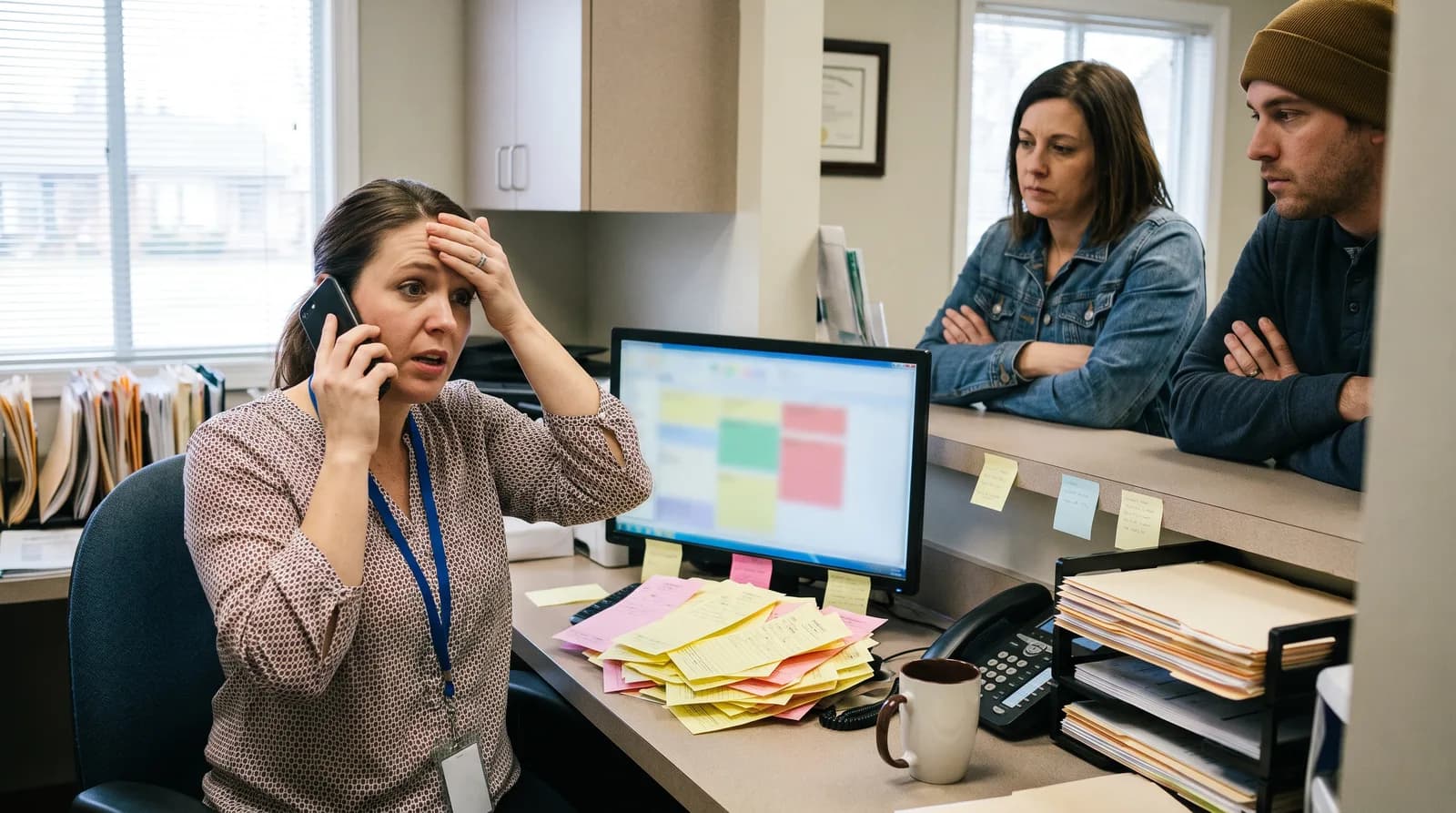
The phone gets watched far less, yet it's usually where the damage starts. A call that rings out at 8:15 on a Monday rarely shows up on a report. The patient who gave up just books with the practice down the street.
That quiet leak is the real cost. When a team is two people short, communication is the first thing to degrade, and it degrades in ways that are hard to see until the new-patient count slips a month later.
The quiet leak
The patient who gave up just books with the practice down the street.
This guide breaks down exactly where those breakdowns happen, why the front desk absorbs the worst of it, and how to steady patient communication without adding heads you can't hire.
What this guide covers
1
Where it breaks
Missed calls, inconsistent answers, and rushed conversations.
2
Why the desk absorbs it
Call volume, overload, and emotional strain on the front line.
3
How to steady it
Automation done responsibly, plus a first-steps plan that needs no new hires.
For a wider view of the pressures owners juggle, see our look at the hardest part of running a dental practice.
How Serious Are Dental Staffing Shortages for Patient Care?
Dental staffing shortages affect front desk teams, dental assistants, hygienists, and administrative staff. Fewer hands mean more responsibilities per person, often without a reduction in patient volume. The ADA Health Policy Institute found that about 62% of dentists named staffing shortages their biggest 2025 challenge, the top response.
The strain reaches clinical roles too. According to April 2026 ADA Health Policy Institute data, only 60% of dentists have an adequate number of dental hygienists on staff, which pushes more scheduling and communication work onto an already thin team.
What Is Driving Dental Staffing Shortages?
Common causes include:
-
Increased burnout post-pandemic
-
Limited availability of trained dental staff
-
Rising operational costs restricting hiring
-
High turnover in front-office roles
How Does Reactive Communication Take Over?
The result is an environment where communication becomes reactive instead of intentional. Coverage gaps are where that shows up first, as this guide to dental phone coverage across every hour of the day lays out.
Where Do Patients Slip Through the Cracks?
And reactive communication has a pattern. Calls get triaged by whoever is closest to the phone, not by urgency. Messages pile up in three places at once: the voicemail box, the website form, and a stack of sticky notes by the keyboard. Nothing is truly lost, but nothing is reliably found either. That gap is where patients slip through. Knowing when calls actually arrive helps, and how dental call volume follows an hourly curve shows where the desk is most exposed.
Related: A short-staffed front desk shows warning signs long before anyone calls it a crisis. 7 signs your dental front desk is overwhelmed →
How Do Dental Staffing Shortages Disrupt Patient Communication?
Missed Calls and Delayed Responses
When front desk teams are overwhelmed, incoming calls often go unanswered or are rushed. Patients trying to book appointments, confirm insurance details, or ask follow-up questions experience delays or give up entirely. The friction that makes callers give up is unpacked in why patients abandon dental calls before booking.
Every missed call is a missed opportunity.
Voicemail rarely closes the gap. Most new patients won't leave a message, and the ones who do expect a callback faster than a stretched team can manage. By the time someone returns the call, the patient has often booked elsewhere. The voicemail box feels like a safety net. It isn't.
Related: The math on voicemail is worse than most owners assume. Why dental voicemail loses patients →
Inconsistent Messaging
Overworked staff may provide incomplete or inconsistent information. This can lead to confusion around appointment times, treatment plans, or billing, increasing patient frustration.
Reduced Personalization
Strong patient communication relies on attention and empathy. Staffing shortages limit the time available for meaningful conversations, making interactions feel transactional rather than supportive. Even the first ten seconds count, as what dental callers actually hear on the phone makes clear.
How Do Dental Staffing Shortages Affect the Patient Experience?
Dental staffing shortages affect the patient experience in three ways: slower responses lower satisfaction, missed reminders raise no-shows, and rushed conversations wear down trust. Clinical care can stay excellent while these communication gaps still push patients toward other practices.
Lower Patient Satisfaction
Patients expect clear, timely communication. When emails go unanswered or callbacks are delayed, satisfaction drops even if clinical care remains excellent.
Increased No-Shows
Poor communication directly contributes to missed appointments. Without timely reminders or easy rescheduling options, patients are more likely to forget or disengage. When those slots open up, filling dental schedule gaps quickly keeps the chair time from going to waste. ADA Health Policy Institute polling found schedules averaged 85% full in July 2022, with patient no-shows and late cancellations largely to blame for the open slots.
Trust Erosion
Communication gaps create uncertainty. Over time, this erodes trust and increases the likelihood that patients will seek care elsewhere. That same erosion shows up online, as how an AI receptionist improves dental patient reviews explains.
Dental staffing shortages and no-show numbers at a glance
62%
of dentists named staffing shortages their top 2025 challenge (ADA Health Policy Institute)
60%
of dentists have an adequate number of dental hygienists on staff (ADA Health Policy Institute, April 2026)
25%
fewer no-shows with text-message reminders in a healthcare meta-analysis (15% vs 21%)
What Does Poor Patient Communication Actually Cost a Practice?
Poor communication during dental staffing shortages costs a practice in three measurable ways: lost new patients from unanswered calls, lost production from no-show appointments, and lost retention from eroded trust over time. Each one quietly compounds the next, and none of them ever appear on a single line of a daily production report.

What Do Missed Calls Cost in Practice?
Put rough numbers to it. A three-provider practice taking 200 calls a week that misses one in five during peak hours loses around 40 contacts weekly. Even if only a handful were new patients, the annual value of those lost chairs adds up fast. The table below maps each breakdown to what it quietly drains. For a closer look at the dollars, see how unanswered calls cost a dental practice revenue.
| Communication breakdown | What patients experience | What the practice loses |
|---|---|---|
| Unanswered calls | Ring-out during peak hours, no callback | New-patient bookings |
| Missed reminders | Forgotten appointments, last-minute cancellations | Same-day production from empty chairs |
| Inconsistent answers | Conflicting info on cost, timing, or insurance | Trust and repeat questions that eat staff time |
| Slow follow-up | Treatment questions left hanging for days | Case acceptance and long-term retention |
Which Losses Are Easiest to Miss?
Read down the right column. None of those losses trigger an alarm. They show up as a slightly thinner schedule, a few more gaps in hygiene, a review that mentions "I could never get through." Knowing which calls drive the most value helps you protect them first. Our breakdown of the top dental call types patients make shows where to focus, and dental call analytics covers the metrics that reveal the leak early.
See where your calls are slipping
Before you fix anything, find out how many calls go unanswered and what they were about. Call analytics make the invisible leak visible.
Read the call analytics guide →Why Are Front Desk Teams Hit Hardest by Dental Staffing Shortages?
Front desk teams are hit hardest by dental staffing shortages because they carry every inbound call, check-in, insurance question, and billing conversation at once. When headcount drops, the phone and the patient standing at the counter end up competing for the same person.
High Volume, High Pressure
Front desks handle scheduling, billing inquiries, insurance coordination, and patient questions all while managing in-person traffic.
Cognitive Overload
Multitasking under pressure increases the risk of errors, miscommunication, and burnout.
Emotional Strain
Front-line staff often absorb patient frustration caused by delays they didn’t create, further accelerating turnover.
That last part is the trap. Turnover makes the shortage worse, which makes communication worse, which makes the job harder, which drives more turnover. Breaking the loop usually means taking repetitive load off the desk before you lose another person, not after. We cover the warning signs and fixes in our guide to reducing dental front office burnout.
For the AI-specific piece of that fix, how AI reduces dental front desk burnout looks specifically at where an AI receptionist absorbs that repetitive load.
How Can Automation Support Communication Responsibly?
Automation is not about replacing people. It’s about supporting limited teams so they can communicate better, not faster. Bringing the team along matters as much as the tool, as introducing an AI receptionist to dental staff shows.
Automated Appointment Reminders
SMS and email reminders reduce manual follow-ups and lower no-show rates. A meta-analysis of text-message reminders found patients were 25% less likely to miss appointments (15% vs 21%). Human outreach still matters: a systematic review of hospital appointment reminders found a benefit in all but one study, though manual phone calls outperformed automated ones.
Call Routing and Virtual Reception
Automated call handling ensures patient inquiries are acknowledged, even when staff are busy.
Centralized Communication Logs
Automation tools help track conversations across channels, ensuring continuity and clarity.
When implemented thoughtfully, automation restores balance without sacrificing the human touch. Patient comfort matters here, and what the data says about whether patients like AI receptionists is worth reading before you decide.
How Can a Lean Team Cover the Phones Without Hiring?
A lean team covers the phones by letting automation catch the routine, repeatable calls so staff can focus on the conversations that actually need a human. Most incoming calls are predictable: scheduling, appointment confirmations, basic insurance questions, and after-hours requests. Those are exactly the kind of calls a reliable system can answer consistently, every time, without tying up the desk.

Which Calls Should Automation Catch First?
Start with the calls that come in when no one can pick up. After-hours and lunch-hour calls are pure leakage, and they're the easiest to capture without adding payroll. From there, layer in confirmations and recall so the desk stops chasing patients one number at a time. Each layer hands a few hours back to the team every week. The moment a call moves to a person matters too, so review how a smooth AI to staff handoff feels to patients.
Where Should a Person Take Over?
The point isn't volume for its own sake. It's freeing human attention for the calls where empathy and judgment matter: a nervous patient, a complex treatment plan, a billing dispute. Routing makes that split work, sending urgent calls to a person and handling the rest automatically. See how AI call routing triages urgent versus routine calls and how practices answer dental calls after hours without hiring.
Stop losing after-hours and lunch-hour calls
The calls that ring out when the desk is closed or slammed are the easiest revenue to recover. A consistent system catches them every time.
See how after-hours coverage works →How Much Should a Practice Automate?
During dental staffing shortages, a practice should automate repetitive, low-risk tasks such as confirmations and basic questions, and keep people on complex, emotional, or high-value conversations. That balance, intentional augmentation, protects patient trust while technology absorbs the volume that would otherwise spill over onto a thin team.
What Is Intentional Augmentation?
The goal is not full automation but intentional augmentation. Practices should focus on:
-
Automating repetitive, low-value tasks
-
Preserving human interaction for complex or emotional conversations
-
Giving staff tools that reduce stress, not add complexity
How Can a Practice Sort Its Calls?
One practical way to start: write down every repetitive question your desk answers in a week. Hours, address, "are you taking new patients," "do you take my insurance." Those belong to a system. The conversation about whether a patient is ready for an implant does not. Sorting your communication this way, instead of automating everything or nothing, is what keeps the human touch intact. A reliable appointment confirmation workflow and steady recall reminders that patients actually answer tend to be the highest-return places to begin.
This approach improves communication quality while protecting team morale.
What Should Practices Do First During Dental Staffing Shortages?
During a staffing shortage, practices should first protect the calls that drive revenue, then automate the repetitive tasks draining the front desk, and reserve human time for the high-value conversations that build trust. Fix the leak before optimizing anything else, because a polished workflow still loses patients if the phone goes unanswered.
In What Order Should Practices Act?
Work in this order. It moves the needle fastest with the least disruption.
- Measure the leak. Pull a week of call data. Count unanswered calls, peak ring-out times, and what callers wanted. You can't fix what you can't see.
- Capture after-hours and overflow first. These are the easiest wins and they don't touch your current workflow.
- Automate confirmations and recall. This is where most no-shows hide, and it gives the desk back the most time.
- Standardize answers. Build short scripts for the five questions you hear daily so messaging stays consistent no matter who picks up.
- Protect human conversations. Route complex and emotional calls to a person. Keep the warmth where it counts.
Does a Practice Need a Full Overhaul?
Notice what isn't on that list: a full system overhaul. You don't need one. If you're comparing tools as you go, our dental patient communication software buyer guide walks through what to look for and which questions to ask vendors. And once treatment is done, post-treatment follow-up calls are an easy place to keep patients feeling cared for without extra desk load.
What Is the Long-Term Outlook?
Dental staffing shortages are unlikely to disappear overnight. However, their impact on patient communication can be managed. With the right systems in place, practices can maintain trust, clarity, and consistency even with lean teams.
Keep every patient call answered, even when you're short-staffed
See how dental teams cover phones around the clock without adding headcount, so missed calls stop turning into lost patients.
Compare phone coverage options →Frequently Asked Questions
Many dental practices are experiencing staffing shortages, especially at the front desk. This means fewer people are answering calls, returning messages, and managing schedules, which can lead to longer wait times or missed calls.
Yes. While clinical care may still be excellent, delayed reminders, unclear instructions, or billing confusion can cause missed appointments, treatment delays, and added stress. Patients often judge a practice by how easy it is to reach, so communication gaps can push them toward other offices.
Many practices use automated text or email reminders sent a few days before the visit, with an easy way to confirm or reschedule. A meta-analysis found text reminders made patients 25% less likely to no-show, and they free staff for patients in the office.
When used responsibly, automation handles only routine messages and follows the practice's privacy rules. Anything personal, sensitive, or complicated still goes to trained staff. Ask any vendor how patient data is stored and how calls are handed to a person before you switch it on.
Cost varies with call volume, features, and integrations, so ask vendors for quotes based on your actual call counts. A useful test is to compare the monthly fee against the new-patient calls and no-show slots your practice loses today, then decide what recovering a few would be worth.
It varies by tool. Reminder and confirmation systems often lower no-shows within the first few weeks of use. Call-capture results tend to show up faster, since recovered after-hours and overflow calls convert almost immediately into booked appointments that would otherwise have been lost.
Yes. Automation handles repetitive tasks like confirmations, after-hours calls, and routine questions, so staff keep their time for complex, emotional, or high-value conversations. It works best as support for the team, not a substitute for the people patients trust.
Yes. Unanswered calls cost new-patient bookings, missed reminders leave chairs empty, and slow follow-up can cost case acceptance. These losses rarely appear on a production report, but they show up as a thinner schedule within weeks.
Sources & References
- 1
- 2
- 3
- 4
- 5
- 6
Topics
Was this article helpful?
Written by
DentalBase Team
Expert dental industry content from the DentalBase team. We provide insights on practice management, marketing, compliance, and growth strategies for dental professionals.