Dental Call Analytics: 7 Metrics That Drive Revenue

Dental call analytics turn front desk reporting into revenue decisions. See the 7 metrics that matter and benchmarks by practice size.
Share:
Table of contents
Dental call analytics turn the front desk phone from a black box into a measurable revenue engine. Most practices still track calls the way they did in 2010: a paper sheet, a vague sense that "we missed a few today," and a monthly glance at new patient counts. That gap between gut feeling and actual phone performance is where the lost revenue hides.
Industry data suggests roughly one in three inbound calls to dental offices goes unanswered or is abandoned before booking. Some of those callers try again. Most don't. They dial the next practice on the search results page, and the revenue follows them.
The rest of this article covers three things: which numbers actually correlate with collected production, what a usable dashboard should show by Monday morning, and how solo offices and group practices should benchmark differently.
What Are Dental Call Analytics, and Why Do They Matter?
Dental call analytics are the structured measurement of inbound and outbound phone activity: who called, when, whether the call was answered, how long it took to answer, what the call was about, and whether it converted to an appointment. The output is a dashboard, not a stack of voicemails.
The "why" comes down to math. A typical solo practice fields between 300 and 500 inbound calls per week. Even a 10% answer rate gap means 30 to 50 missed conversations weekly, and a fraction of those were new patients worth thousands in lifetime value. Multiply across a year and the leakage easily clears six figures per location. The ADA Health Policy Institute publishes ongoing research on practice operations that consistently flags front desk capacity as a constraint on growth. For most owners, the phone is one of the hardest parts of running a dental practice precisely because it's been invisible.
Without analytics, the front desk has no way to prove the problem exists. Doctors hear "we're slammed" but see no numbers. Office managers schedule by feel. Hiring decisions get made on the third or fourth complaint instead of the first leading indicator.
The difference between call logs and call analytics
A call log is a record. Call analytics are a measurement system. Logs tell you a call happened. Analytics tell you what that call cost or earned, and what to do differently next Tuesday at 9:15 a.m. when the same pattern shows up.
Front desk constantly running behind on calls?
Most overwhelmed teams aren't understaffed. They're under-measured. Start with the leading indicators that explain why the phone is winning.
Read: 7 signs your front desk is overwhelmed →Which Phone Metrics Actually Correlate With Revenue?
Seven metrics carry the bulk of the revenue signal: answer rate, time to answer, booking conversion, peak call windows, call abandonment, after hours leakage, and repeat caller rate. Each one ties to a specific operational decision the front desk or owner can make this week.
The mistake most practices make is tracking call volume and stopping there. Volume tells you nothing about whether the right calls are being captured. A practice can take 400 calls a week and still bleed new patients if booking conversion sits below 50%. Here's what each metric measures, the healthy benchmark, and the red flag that signals action.
| Metric | Formula | Healthy benchmark | Red flag |
|---|---|---|---|
| Answer rate | Answered calls / total inbound | 85% or higher (business hours) | Below 75% |
| Time to answer | Average seconds before pickup | Under 20 seconds | Over 30 seconds |
| Booking conversion | Booked / answered new patient calls | 60% to 75% | Below 45% |
| Peak call windows | Call count by hour, weekday | Staffing matches volume curve | Coverage flat through 8a to 6p |
| Call abandonment | Hung up before pickup / inbound | Under 5% | Over 10% |
| After hours leakage | Calls received outside hours | Tracked and routed | Voicemail with no callback log |
| Repeat caller rate | Same number, 2+ calls in 24h | Below 8% | Above 15% |
Booking conversion deserves a closer look because it sits closest to revenue. A practice that answers 90% of calls but only books 40% of new patient conversations is leaving more on the table than one with a 78% answer rate and 70% booking conversion. The phone is a sales channel, and the math reflects that.
The repeat caller rate is the most underused diagnostic in dental phone metrics. When the same number rings three times in a morning, something broke: a returned voicemail that never went out, a billing question that got dropped, a confirmation text the patient didn't trust. Dental Economics has covered call handling failures extensively, and repeat callers are almost always a symptom of process breakdown, not patient demand.
Surfacing that call history the instant the phone rings, before your team even says hello, is exactly what caller ID screen pop context is built to solve.
How Does a Call Analytics Dashboard Replace Gut Feeling With Data?
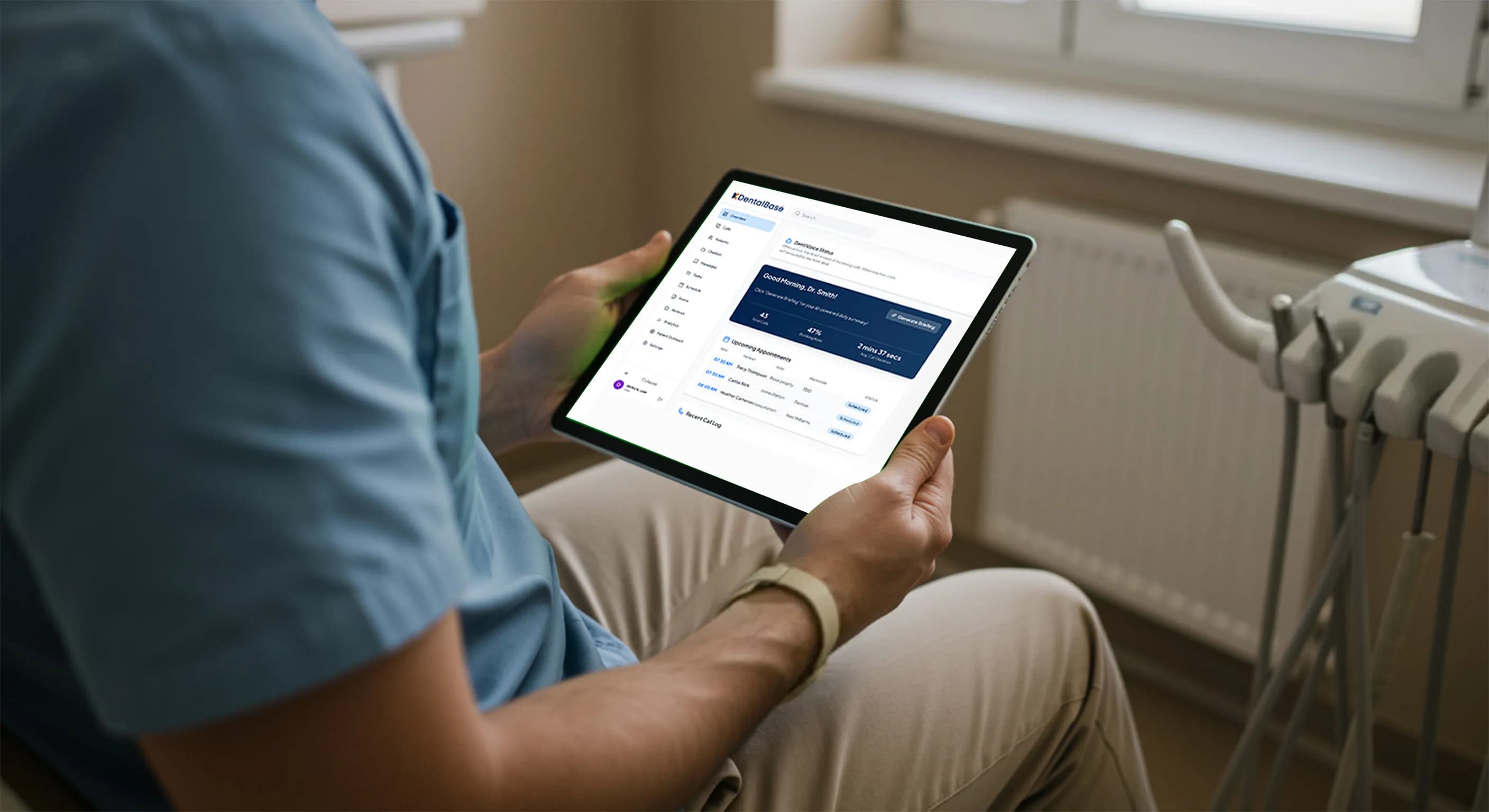
A call analytics dashboard replaces gut feeling by showing the front desk three things on one screen: real-time call status, daily trend lines, and a rolling weekly conversion view. Decisions move from anecdote to evidence. The Monday huddle stops being a vibe check and starts being a review.
Here's the operational shift. Without a dashboard, an office manager hears "we were swamped Wednesday." With a dashboard, that same manager sees Wednesday had 47 calls between 9:00 and 10:30 a.m., the second receptionist was at lunch from 9:15 to 9:45, and 11 calls abandoned in that window. The conversation goes from "let's hire more help" to "let's move lunch to 11:30."
That precision compounds. After eight weeks of weekly review, most practices identify three or four recurring patterns: lunch coverage, post-lunch dip, end-of-day call surge before close. Each pattern has a fix that doesn't require new hires. The KPIs and ROI framework for AI receptionists applies the same logic to automated coverage, but the underlying analytics discipline matters whether the practice uses AI or not. McKinsey's healthcare practice has tracked the same shift in primary care and specialty operations: weekly leading indicators beat monthly lagging ones for decision speed.
Call type segmentation is the next layer. Once a practice can answer "how many calls came in?" it should be able to answer "and what were they about?" New patient inquiries, scheduling, billing, and clinical questions each have different handling needs. Call routing logic only works when the analytics underneath tag each call by reason.
For the full list of buckets worth tagging, our breakdown of what patients actually call about covers the ten categories most dental practices see.
What a weekly review actually looks like
The review is 15 minutes, every Monday, between the office manager and the doctor or DSO regional. Three questions:
- What was last week's answer rate, and which day was the worst?
- How many new patient calls converted to booked appointments?
- What's the one operational change for this week based on what we saw?
That's it. Not a quarterly business review with charts. A weekly tactical review that closes the loop between data and decision. Practices that hold this meeting consistently outperform peers on collected production growth, mostly because they're catching small breakdowns before they compound.
See every call captured, scored, and tagged
DentiVoice gives your practice a real-time dashboard with answer rate, booking conversion, peak windows, and missed call recovery, alongside the AI receptionist that handles the calls your team can't.
See the DentiVoice dashboard →What Benchmarks Apply to Solo vs. Group Dental Practices?
Solo and group practices need different benchmarks because their call volume, staffing patterns, and call mix don't compare cleanly. A two-provider office handling 80 inbound calls a day reads its numbers differently than a 12-location DSO routing 1,500. Healthy looks different at each scale.
Volume changes what "healthy" means. A solo office can run a 90% answer rate when the front desk has visibility on every ring. A 10-location group with shared call routing tends to plateau at 80% to 85% because of routing complexity, time zone spread, and call type variety. Both can be performing well. The benchmark just isn't the same.
| Metric | Solo (1 to 2 providers) | Group (3 to 10 locations) | DSO (10+ locations) |
|---|---|---|---|
| Daily call volume | 60 to 120 | 200 to 600 | 800 to 3,000+ |
| Answer rate target | 88% to 92% | 82% to 88% | 78% to 85% |
| Time to answer | Under 15 sec | Under 25 sec | Under 30 sec |
| Booking conversion | 65% to 75% | 60% to 70% | 55% to 65% |
| Reporting cadence | Weekly | Weekly + monthly roll-up | Rolling 28-day, by location |
| Segmentation needs | By day of week | By location and day | By location, day, provider, call type |
The biggest analytics shift between solo and group practice is segmentation. A solo office can look at one weekly number and act. A 12-location group has to look at the same metric sliced by location, because aggregate numbers mask the location that's bleeding new patients. DSO call management at scale lives or dies on this segmentation, not on the aggregate dashboard.
The reporting cadence shift matters too. Solo practices can react weekly because the call volume is small enough that one bad day doesn't get drowned out. Multi-location groups need rolling 28-day windows so weekly noise doesn't trigger overreactions. In mature multi-location reporting, rolling windows are the consistent pattern across operators, because weekly noise in any single office can drown out the underlying trend at the group level.
Related: Running a multi-location group? Standardizing call reporting across offices is its own challenge. → Read the DSO call management guide
Why Does Standard Front Desk Reporting Miss What Dental Call Analytics Catch?
Standard front desk reporting tracks outcomes (appointments booked, production scheduled, new patients seen) without the leading indicators that explain why those numbers move. Dental call analytics expose the cause, not just the effect. That's the gap most practices don't realize they have until they close it.
Look at it this way. New patient counts are a lagging indicator. By the time they drop, the leakage already happened weeks ago, and it's nearly impossible to reconstruct what went wrong on which day. Dental front desk reporting that lives in the practice management system shows the booked outcome but doesn't tell you that 23 callers hung up between 12:15 and 1:45 p.m. last Thursday.
Three common decisions get made wrong without phone data:
- Staffing: Practices hire when complaints peak, often six months after the phone bottleneck started. Analytics catches the trend on week two.
- Marketing spend: Owners pour money into new patient ads while 40% of inbound calls go unanswered. The leak is bigger than the funnel.
- Hours of operation: Offices extend hours based on doctor preference rather than where the after hours call data points. After hours call coverage only pays off when the volume data justifies it.
The deeper issue is that lagging indicators feel safer to track because they're tied to revenue everyone already understands. Leading indicators take a few weeks of discipline before the connection to revenue becomes obvious. Most practices give up before that connection clicks. The ones who don't tend to compound performance gains for years.
What "obvious" front desk reporting misses
A practice management dashboard typically shows the calendar, production goal, and collections. None of those numbers tell the front desk anything actionable about the phone. NIDCR research on oral health access regularly highlights operational barriers, and broader practice research consistently shows front desk efficiency is one of the largest non-clinical drivers of practice profitability. Yet the typical dental office can't answer basic questions like "what's our weekly booking conversion?" without manual chart pulling. If the phone always feels busy, dental call analytics will tell you whether it actually is or whether it just feels that way during specific hours.
How Should You Roll Out Dental Call Tracking in Your Practice?
Roll out dental call tracking in four phases over two to four weeks: pick the 4 to 6 metrics you'll track first, capture the data through a phone system or analytics tool, build a 15-minute weekly review ritual, and tie each metric to one operational decision. Don't try to track everything on day one.
The biggest rollout mistake is starting with too many metrics. Practices that try to track 12 things at once end up tracking none of them after a month. Start with three: answer rate, booking conversion, and peak call windows. Add a fourth (after hours leakage or repeat caller rate) once the weekly review feels routine.
The four-phase rollout
- Week 1: Baseline. Pull whatever call data the current phone system has and benchmark the three core metrics. Don't fix anything yet. Just measure.
- Week 2: Visibility. Build a one-page dashboard or shared spreadsheet the front desk and owner both see. The data needs to live somewhere, not in someone's head.
- Week 3: First decision. Pick the single weakest metric and make one operational change. Move a lunch break, add a midday coverage hour, redirect after hours to a callback service or AI.
- Week 4: Cadence. Schedule the weekly review as a recurring 15-minute meeting. The cadence is the system, not the dashboard.
Most practices can stand up the basics in two weeks with existing tools, even before bringing in a dedicated analytics platform. The constraint is rarely technology. It's the discipline of looking at the numbers every Monday and acting on what they say.
Dental Call Analytics Readiness Scorecard
Check each item you can answer with real data, not gut feeling.
Your score: count your checks out of 7. Below 3 means you're flying blind. 6 or 7 means your analytics discipline is doing its job.
One more practical note. The front desk team needs to be part of the rollout, not the subject of it. When the dashboard arrives as a surveillance tool, it gets quietly sabotaged. When it arrives as a way to prove the team is overwhelmed and needs help, it gets defended. The framing matters as much as the metrics. Front office burnout is real, and analytics is the evidence that gets leadership to act on it. Industry forums like DentalTown document the same pattern in practitioner threads year after year, where teams resist tools that feel like monitoring and adopt the ones that argue on their behalf. If recordings or transcripts are part of the stack, those should be reviewed under the practice's standard HIPAA program before rollout, not after.
The core insight isn't that dental call analytics generate more data. They replace one big lagging number (new patients seen) with three or four leading indicators that explain why that number moves. Practices that operate on leading indicators make smaller, faster corrections. Practices that wait for the lagging indicator to drop fix problems weeks after the revenue already left.
Start with three metrics this week. Answer rate, booking conversion, and peak call windows. Build the 15-minute Monday review. Pick one operational change. By month two, the front desk stops being a black box and starts being a measurable revenue channel, which is the entire point.
Turn your phone into a measured revenue channel
DentiVoice gives your practice a real-time call analytics dashboard plus an AI receptionist that captures the calls your team can't answer. Every metric, every call, every booking, in one view.
Book a DentiVoice demo →Want to go deeper on the metrics side?
Read: Measuring AI receptionist success with KPIs and ROI →Frequently Asked Questions
Dental call analytics is the structured measurement of inbound and outbound phone activity, including who called, when, whether the call was answered, how long it took, and whether it converted to an appointment. It turns the phone into a measurable revenue channel rather than a black box.
Most solo and small group practices should target 85% or higher during business hours, with 88% to 92% being achievable for well-staffed solo offices. Multi-location DSOs typically run 78% to 85% because of routing complexity and call mix variety across offices.
Dental call tracking exposes the leading indicators behind front desk performance: peak hours, abandonment patterns, and booking conversion rates. That data turns vague complaints about being swamped into specific operational decisions like adjusting lunch breaks or adding midday coverage.
Dental phone metrics measure inbound and outbound call activity directly. Front desk reporting tracks outcomes like appointments booked and production scheduled. Metrics are leading indicators; reporting is lagging. You need both, but most practices only have the lagging half today.
Most practices can stand up basic call analytics in two to four weeks using their existing phone systems. The constraint is rarely the technology. It's the discipline of building a 15-minute weekly review and acting on the data instead of just watching it.
Booking conversion (booked appointments divided by answered new patient calls) sits closest to revenue. A practice with a 90% answer rate and 40% booking conversion bleeds more new patient value than one with a 78% answer rate and 70% booking conversion.
Yes. Solo practices can act on weekly numbers because volume is small enough that one bad day stands out. Multi-location groups need rolling 28-day windows segmented by location, because aggregate numbers hide which office is actually bleeding new patients.
Sources & References
- 1
- 2
- 3
- 4
- 5
Topics
Was this article helpful?
Written by
DentalBase Team
Expert dental industry content from the DentalBase team. We provide insights on practice management, marketing, compliance, and growth strategies for dental professionals.