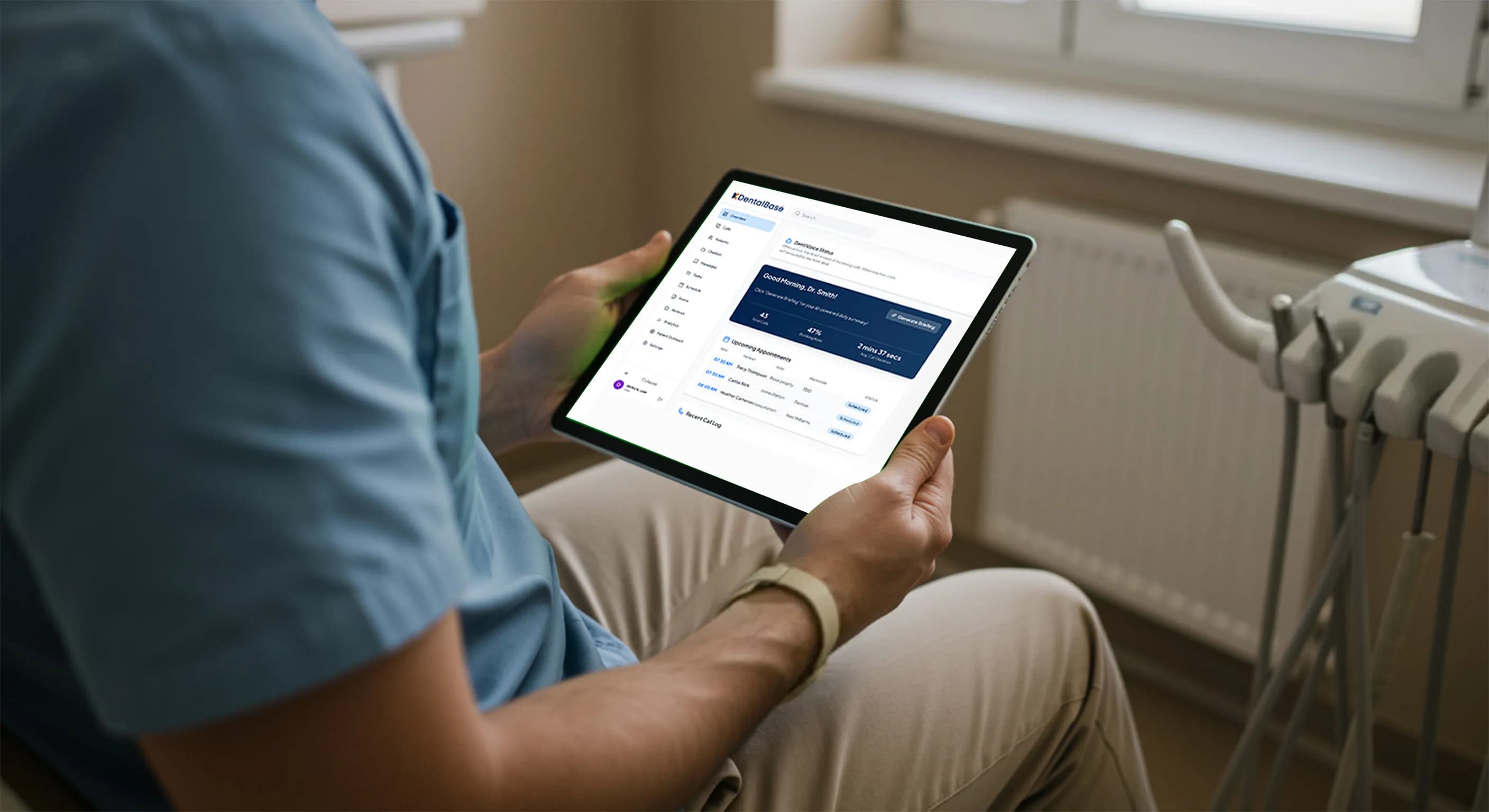
Can AI Replace Dental Receptionists? A Practical Guide

Can AI replace dental receptionists? See what AI handles at the front desk, what still needs your team, and how to add AI to your practice safely.
Share:
Table of contents
Why Are Dental Practices Asking If AI Can Replace Their Receptionists?
Dental practices ask because front-desk turnover and hiring costs keep climbing, and AI looks like a fix. The short answer to can AI replace dental receptionists is not fully. AI handles routine scheduling, reminders, and after-hours calls, while your team keeps the sensitive, complex conversations.
By the DentalBase Content Team | Updated October 15, 2026
DentalBase builds DentiVoice, an AI receptionist for dental practices. This guide draws on ADA, HHS, and HIPAA Journal sources.
The Staffing and Cost Pressures Behind the Question
Staffing and cost pressure have gotten worse, not better. Turnover is a constant strain in dental offices, and every front desk vacancy adds to it. Those vacancies strain more than the team, and the patient experience cost of front desk staffing shortages shows up in missed calls and lower satisfaction.
The question “Can AI replace dental receptionists?” is increasingly common today. Many owners are exploring technology that could keep front desk operations steady, and some ask whether AI could take over the role entirely. The shortage behind that search is real: in any given month, roughly 40% of U.S. dental practices are trying to hire a dental assistant or hygienist, according to the ADA Health Policy Institute.
Related: Staffing turnover and hiring costs are pushing many practices to model the numbers before choosing a solution. See how AI receptionist ROI and payback periods work →
~40%
of U.S. dental practices are trying to hire a dental assistant or hygienist in any given month, per the ADA Health Policy Institute.
Where AI Realistically Fits Today
AI in dentistry has moved fastest on the administrative side, especially automated scheduling and patient communication. Whether it can take over the front desk entirely is a different question, and it depends on what receptionists actually do and where technology supports them instead of substituting for them. The global AI-in-healthcare market was valued at $36.7 billion in 2025 and is projected to grow at a 38.9% CAGR through 2033, according to Grand View Research. That growth brings real stakes: a HIPAA Journal analysis of HHS data found more than 133 million patient records were breached in 2023, which is exactly why any AI tool touching PHI needs the same safeguards a human receptionist follows.
Rather than chasing wholesale replacement, many practices are finding a better path: AI as a support tool. It takes the repetitive work and leaves the personal touch to your team. That protects the relationships that drive patient loyalty and practice growth.
What Do Dental Receptionists Actually Do Today?
Dental receptionists are the primary point of contact, practice ambassadors, and operational coordinators, handling far more than appointment booking. That range is why AI in dentistry gets tested at the front desk first, and why replacing the role is harder than automating its tasks.

Core Front-Desk Responsibilities
Dental receptionists handle appointment scheduling, insurance verification, payment processing, and patient check-in procedures. They manage complex scheduling requirements and coordinate with dental assistants and hygienists. They handle emergency scheduling requests and maintain accurate patient records. These tasks require understanding insurance protocols and practice-specific procedures. They also require the ability to adapt to constantly changing schedules. That load has grown. More than a third of dentists report that workload division between themselves and their team has shifted since the pandemic, with front-desk and clinical staff absorbing extra duties, according to the ADA News.
Additionally, receptionists manage phone systems and handle billing inquiries. They process payments and coordinate referrals with dental labs and specialists. They often serve as the first point of contact for new patients. They explain procedures, costs, and while representing the practice's values. These diverse duties are central to the discussion of whether AI can take over front-desk work, as they highlight the blend of administrative skill and human interaction required. They also represent the practice's professionalism.
Human Skills AI Cannot Replicate
The emotional intelligence required for patient care extends beyond technical tasks. Dental receptionists comfort anxious patients and handle sensitive billing conversations. They manage upset patients during emergencies and build relationships encouraging patient retention. They read body language and adjust communication styles based on individual patient needs. They provide empathetic support that transforms a clinical environment into a welcoming space. This emotional connection is a key factor when weighing whether AI could ever fully staff the front desk. That emotional load is also what wears people down over time, and practical ways to prevent front desk burnout covers how to protect the team that carries it.
These human elements include empathy, intuition, cultural sensitivity, and handling complex interpersonal situations. They represent irreplaceable aspects of the receptionist role that technology cannot fully replicate.
Can AI Replace Dental Receptionists Completely?
No, AI cannot fully replace dental receptionists. Current AI technology excels at specific, well-defined tasks like scheduling and reminders, but it struggles with complex human interactions and decision-making, which characterize much of the receptionist role.
Tasks AI Can Automate Reliably
AI systems demonstrate impressive capabilities in several areas, particularly for routine cleanings and check-ups. Advanced AI can manage calendar optimization and send automated reminders. Advanced AI can handle basic insurance verification and process online payments. These systems work 24/7 and reduce no-shows through consistent follow-up. These systems also provide patients with convenient self-service options.
AI-powered chatbots can handle frequently asked questions about office hours and location. They also cover accepted insurance plans and basic procedure information. Voice AI systems can manage initial call routing and collect basic patient information. They can also schedule appointments for straightforward cases. These applications free up human staff for more complex interactions. They maintain consistent service availability.
Tasks That Still Require Humans
Complex insurance inquiries, treatment plan explanations, and financial consultations require human judgment. They also require communication skills that current AI cannot match. When patients have multiple insurance plans, require prior authorizations, or need payment arrangements. Human receptionists can navigate these situations with flexibility and understanding.
Emergency situations demand immediate human intervention. When a patient calls with severe pain or needs urgent care. Receptionists must assess the situation and provide appropriate guidance. They must coordinate rapid response with clinical staff during dental emergencies. The ability to recognize urgency levels, provide reassurance, and make real-time decisions remains distinctly human. These skills are central to the debate over how much of the front desk AI can realistically take on.
Handling upset patients and managing billing disputes require empathy and cultural sensitivity. Providing emotional support during a hard conversation also demands interpersonal skills beyond current AI capabilities. The question of whether AI can replace dental receptionists becomes less relevant. This is especially true when considering these essential human elements.
Related: Handling upset patients and emergencies well is one of the clearest lines between AI support and human judgment. Read how AI receptionists handle difficult patient calls →
How Do AI and Human Receptionists Compare Side by Side?
Whether AI can replace dental receptionists depends on the task: AI wins on availability and consistency, while humans win on empathy and judgment. The table below breaks down five areas where the two differ most: availability, problem-solving, empathy, consistency, and the ability to learn from context.

AI vs. Human Receptionists, Function by Function
| Function | AI Systems | Human Receptionists |
|---|---|---|
| Availability | 24/7 consistent service | Limited to office hours |
| Complex Problem Solving | Limited to programmed responses | Creative, adaptive solutions |
| Emotional Support | Scripted responses only | Genuine empathy and understanding |
| Consistency | Identical service delivery | Variable based on individual skills |
| Learning Ability | Data-driven pattern recognition | Contextual understanding and intuition |
AI systems excel in consistency and availability but lack the nuanced understanding necessary for complex patient interactions. Human receptionists provide irreplaceable emotional intelligence and problem-solving flexibility but require management, training, and competitive compensation. The most effective approach combines AI efficiency with human expertise, creating a hybrid model that maximizes both technological capabilities and human strengths.
What Is an AI Dental Assistant, and How Does It Differ From an AI Receptionist?
An AI dental assistant is software that takes on administrative work, such as answering calls, booking visits, and sending reminders. An AI receptionist is the front-desk version of that idea. Neither replaces a chairside assistant, whose work is hands-on and clinical.
AI in dentistry also covers clinical tools, like software that flags findings on radiographs for a dentist to review. Those tools support diagnosis, not the phone. For most owners, AI for dental practices starts at the front desk because the tasks are repetitive, easy to measure, and easy to hand to a person when a call gets complicated.
Quick Check: Where Does Your Front Desk Need the Most Help?
Check each item you have completed.
Your score: count your checks out of 5
How Does AI Support the Front Desk in Real Practice?
AI helps most in narrow, repetitive moments: after-hours calls, no-show reminders, and a phased rollout. Three scenarios below show where that support pays off. For the call data and vendor questions behind that approach, read the case for an AI receptionist that supports your front desk.
Why Does AI in Dentistry Start at the Front Desk?
Most AI for dental practices begins at the front desk because the work is repetitive and easy to measure. As AI in dental offices matures, an AI dental assistant that handles calls, reminders, and intake gives staff time back without touching clinical decisions.
Scenario 1: After-Hours Patient Calls
Consider a patient experiencing tooth pain at 8 PM on a Saturday. An AI system can immediately respond, assess urgency through guided questions, provide self-care instructions, and either book an emergency slot or route them to on-call services.
The AI system documents the interaction, prepares the clinical team for Monday morning follow-up, and sends automated reminders about recommended care. When the office reopens, human staff can focus on providing personalized care rather than gathering basic information.
To see what those unanswered evening calls cost a practice in the first place, read what missed after hours calls cost a dental practice.
22.95%
Reduction in dental no-shows after practices added automated appointment reminders, per a Sesame Communications study of 491 practices.
Scenario 2: Reducing No-Shows
AI-powered reminder systems can significantly reduce no-show rates through personalized communication strategies. These systems analyze patient behavior patterns, determining optimal reminder timing and communication preferences for each individual.
A Sesame Communications study of 491 practices found that automated reminders cut dental no-shows by 22.95%, which frees human staff to focus on complex scheduling and patient relationships. It is a clear example of how the discussion should shift from full replacement to how AI can support the front desk.
These practical applications demonstrate that the question "Can AI replace dental receptionists?" misses the point. Instead, AI serves as a powerful tool that amplifies human capabilities while handling routine tasks that don't require emotional intelligence or complex problem-solving skills.
Scenario 3: A Phased Rollout
Follow this sequence:
- Pick one narrow task first.
- Confirm the BAA before go-live, not just discussed.
- Run it silently for 2-4 weeks so staff catch errors before patients do.
- Tell patients what changed with a short notice on the phone tree.
- Expand only once the first task is stable and complaints have dropped to zero.
Related: Seeing how another practice measured the tradeoffs can make the decision easier. Review a real AI receptionist case study and vendor ROI checklist →
What Do HIPAA and Patient Trust Require When You Add AI?
HIPAA requires any AI tool that touches patient data to meet the same privacy bar as your staff, and patients expect to know when they are talking to software. Before any rollout, confirm a signed business associate agreement and a clear handoff to a human.

HIPAA Requirements for AI Tools
All AI systems handling protected health information (PHI) must comply with HIPAA regulations, requiring business associate agreements, encryption protocols, and audit trails for all patient data interactions. AI vendors must demonstrate compliance through security assessments, data handling procedures, and incident response protocols. Skipping that is not minor. HHS’s Office for Civil Rights has fined healthcare providers for treating a vendor as compliant without ever signing a formal agreement, so confirm the BAA is in place before any patient data touches the AI system.
Practices implementing AI must ensure that automated systems maintain the same privacy standards as human staff. This includes secure data transmission, limited access controls, and comprehensive logging of all PHI interactions. HIPAA Journal reported that hacking caused 79.7% of large healthcare breaches reported to HHS in 2023, so vendor security is not a formality.
Maintaining Patient Confidence
Patient trust is a critical factor in successful AI implementation. Many patients, particularly older ones, prefer human interaction for sensitive health discussions. Surveys show patients accept AI for basic scheduling, but want human involvement for insurance and treatment discussions.
Transparency about AI usage helps maintain trust. Practices should clearly communicate when patients are interacting with AI systems, provide easy escalation to human staff, and ensure that AI enhances rather than replaces the human elements of patient care. This approach addresses patient concerns while leveraging technological benefits.
The most successful practices implement AI gradually, focusing on behind-the-scenes efficiency improvements before expanding to direct patient interaction. This strategy allows staff and patients to adapt while maintaining the personal relationships that drive patient loyalty and practice success.
What to Confirm Before Signing an AI Vendor Contract
Confirm:
- A signed BAA
- Encryption in transit and at rest
- An audit trail on request
- An incident process
- Staff review of AI scripts pre-launch
Related: Patient comfort with AI varies by generation and by the type of conversation. See the data on whether patients actually like AI receptionists →
Frequently Asked Questions About AI in Dental Offices
Is AI going to replace receptionists?
AI is unlikely to completely replace receptionists but will significantly change their role. Current technology excels at routine tasks like appointment scheduling and reminders but cannot replicate the emotional intelligence and complex problem-solving that characterize quality patient service.
Will dental assistants be replaced by AI?
Dental assistants perform hands-on clinical tasks that require physical presence and human judgment. While AI may automate some administrative aspects of their work, the core functions of patient care, clinical assistance, and equipment management remain distinctly human responsibilities.
Can AI be a receptionist?
AI can perform many receptionist functions but cannot fully replace the human element. AI works as a support tool, handling routine inquiries and administrative tasks while human staff manage complex interactions, provide emotional support, and make nuanced decisions.
What is an AI dental assistant?
An AI dental assistant is software that handles administrative work like answering calls, booking appointments, and sending reminders. It supports your team rather than replacing a chairside dental assistant, whose hands-on clinical work still needs a trained person. AI for dental practices usually starts with the front desk.
How is AI used in dentistry today?
AI in dentistry spans clinical tools, such as software that flags findings on radiographs for a dentist to review, and administrative tools, such as AI receptionists that answer calls, book visits, and send reminders. Practices often start with administrative use because it is easier to measure and supervise.
What Does the Future of the Dental Front Desk Look Like?
The future front desk is a hybrid: AI handles routine inquiries, scheduling, and reminders, while your team handles the interactions that need judgment and empathy. For most practices, the answer to can AI replace dental receptionists is no, and the better question is which tasks to hand off first.
The Hybrid Front-Desk Model
AI excels at routine administrative tasks, 24/7 availability, and consistent service. That lets receptionists focus on problem-solving, emotional support, and the relationships that drive loyalty. This is the modern answer to the question, can AI replace dental receptionists.
Before You Start: AI Implementation Readiness Checklist
Check each item you have completed.
Your score: count your checks out of 5
Implementing AI in Your Dental Practice: A Step-by-Step Approach
Step 1: Identify Quick-Win Tasks First
Start with the most time-consuming administrative tasks, such as appointment confirmations, insurance verification, or basic patient inquiries. They are repetitive, so they return value fastest without asking AI to replace your front desk.
Step 2: Start With a Pilot Program
Pilot an AI chatbot or voice assistant for after-hours inquiries and basic appointment requests. Watch patient feedback closely, and train your reception staff to work alongside the tool as a way to save time, not as a threat to their jobs.
Step 3: Prioritize HIPAA-Compliant Platforms
Choose platforms that are HIPAA-compliant, work with your practice management software, and spell out how patient data is handled.
Step 4: Build Clear Escalation Protocols
Decide when AI hands off to a person. Complex insurance questions, upset patients, and emergencies should always reach your trained team, and staff feedback should keep improving the AI's responses.
Weighing AI against a human hire is easier with the full comparison: how to evaluate software options for 2026, the questions worth asking before you commit to a vendor, and a head-to-head look at AI versus human staff.
Frequently Asked Questions
AI will not completely replace receptionists but will transform their roles significantly. While AI can handle routine tasks like appointment scheduling, basic inquiries, and payment processing, human receptionists remain essential for complex patient interactions, emotional support, and situations requiring empathy and judgment. The future points toward AI-assisted reception work rather than full replacement.
Dental assistants are unlikely to be fully replaced by AI due to the hands-on, clinical nature of their work. AI may assist with administrative tasks like patient record management and treatment planning, but the physical aspects of patient care, chairside assistance, and direct patient interaction require human skills that AI cannot replicate effectively.
AI can perform many receptionist functions including appointment scheduling, answering basic questions, processing payments, and managing patient communications. However, AI works as a virtual assistant handling routine tasks while human receptionists manage complex situations, provide emotional support, and handle sensitive patient concerns that require human judgment and empathy.
An AI dental assistant is software that handles administrative work like answering calls, booking appointments, and sending reminders. It supports your team rather than replacing a chairside dental assistant, whose hands-on clinical work still needs a trained person. AI for dental practices usually starts with the front desk.
An AI dental receptionist improves the patient experience by providing 24/7 availability for booking appointments and answering basic questions. This convenience reduces wait times on the phone and allows patients to interact with the practice on their own schedule. By automating routine tasks, AI also frees up human staff to provide more focused, personalized attention to patients in the office.
AI in dentistry spans clinical tools, such as software that flags findings on radiographs for a dentist to review, and administrative tools, such as AI receptionists that answer calls, book visits, and send reminders. Practices often start with administrative use because it is easier to measure and supervise.
Sources & References
- 1
- 2
- 3
- 4
- 5
- 6
- 7
Topics
Was this article helpful?
Written by
DentalBase Team
Expert dental industry content from the DentalBase team. We provide insights on practice management, marketing, compliance, and growth strategies for dental professionals.