Dental Front Desk Phone Fatigue: Why Calls Drain Teams
Constant ringing and interruptions cause dental front desk phone fatigue. Learn the signs and how call support protects team focus.
Share:
Table of contents
Dental front desk phone fatigue builds quietly. The phone rings during check-in, rings again mid-insurance question, and rings once more while a patient waits at the counter. By mid-afternoon your team has been interrupted more times than anyone counted, and it shows.
It's a close cousin of the strain covered in how AI reduces dental front desk burnout, but it has its own cause: a line that never lets anyone finish a thought. Left alone, it wears down accuracy, mood and the patient experience.
Here's what phone fatigue is, how interruptions hurt accuracy and mood, which signs to watch for, which calls can be routed away from staff, and how to set a calmer phone routine.
What is dental front desk phone fatigue?
Phone fatigue is the mental and emotional drain that comes from constant ringing, task switching and answering calls while patients wait in front of you. At a dental front desk, it shows up as slower work, shorter patience and more small mistakes as the day goes on.
Why does the job create this drain?
It isn't a character flaw. It comes from how the job is built. One or two people check patients in, verify insurance, collect payments, book follow-up visits and answer a line that rings on its own schedule. Every call pulls attention away from the person standing in front of you. Every return to that person takes a moment to refocus.
How is busy different from fatigued?
Busy and fatigued aren't the same thing. A busy hour with a clear plan can feel energizing. Dental front desk phone fatigue is different: it comes from unpredictable interruptions and no way to finish what you started. Predictability matters as much as volume, which is why two offices with the same call count can feel completely different at 4 p.m.
How heavy is the call load?
The load is real. A Dental Economics analysis published in mid-2026 estimates that practices miss 30% to 38% of incoming calls during business hours. In plain terms, the phone keeps ringing even when no one can pick it up. The same analysis assumes 60% to 65% of those missed calls come from new patients, which raises the stakes on every ring.
30% to 38%
of incoming calls are missed during business hours
Source: a Dental Economics analysis, July/August 2026. About 60% to 65% of those missed calls are assumed to be new-patient related.
Does staffing make it worse?
Staffing adds pressure. About 62% of dentists named staffing shortages their top challenge for 2025, according to ADA News. That leaves many front desks covering the phone with fewer hands than they'd like. For the wider picture, common front desk challenges in dental practices maps the other pressure points.
How do constant interruptions affect accuracy and mood?
Constant interruptions make it harder to finish tasks cleanly, so accuracy slips and patience wears thin. Each call forces your team to stop, answer and then rebuild its place, and that rebuild is where small errors and short tempers tend to start.
What happens to accuracy?
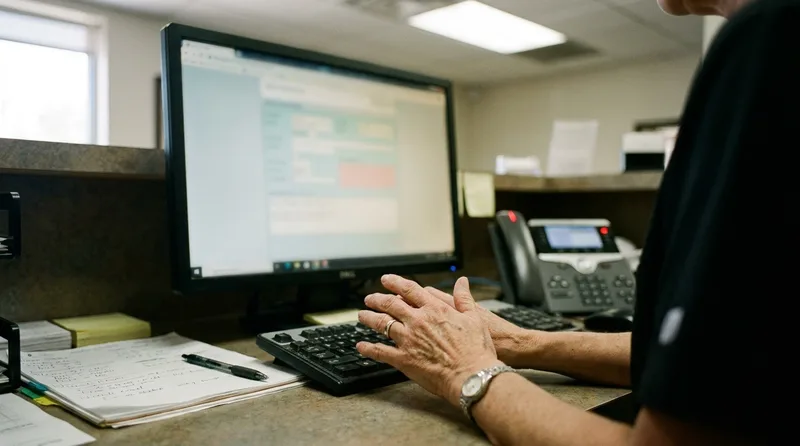
Think about the jobs that need steady attention. Typing a date of birth. Matching an insurance ID. Confirming which provider a patient prefers. A ring in the middle of any of them leaves a half-finished entry and a mental note to come back. Sometimes the note survives. Sometimes it doesn't.
What happens to mood?
Mood follows the same path. Hearing a phone ring while you help someone in person creates a small jolt of guilt toward whoever you set aside. Repeat that thirty times a day and the jolt turns into dread. For background on how sustained pressure affects people at work, the American Psychological Association offers a helpful overview of work stress.
How do patients feel it?
Patients feel it too. A rushed greeting at the counter, or a line that's always busy, sends people elsewhere. That pattern is covered in why a dental office phone is always busy, and it's often a symptom of the same overload.
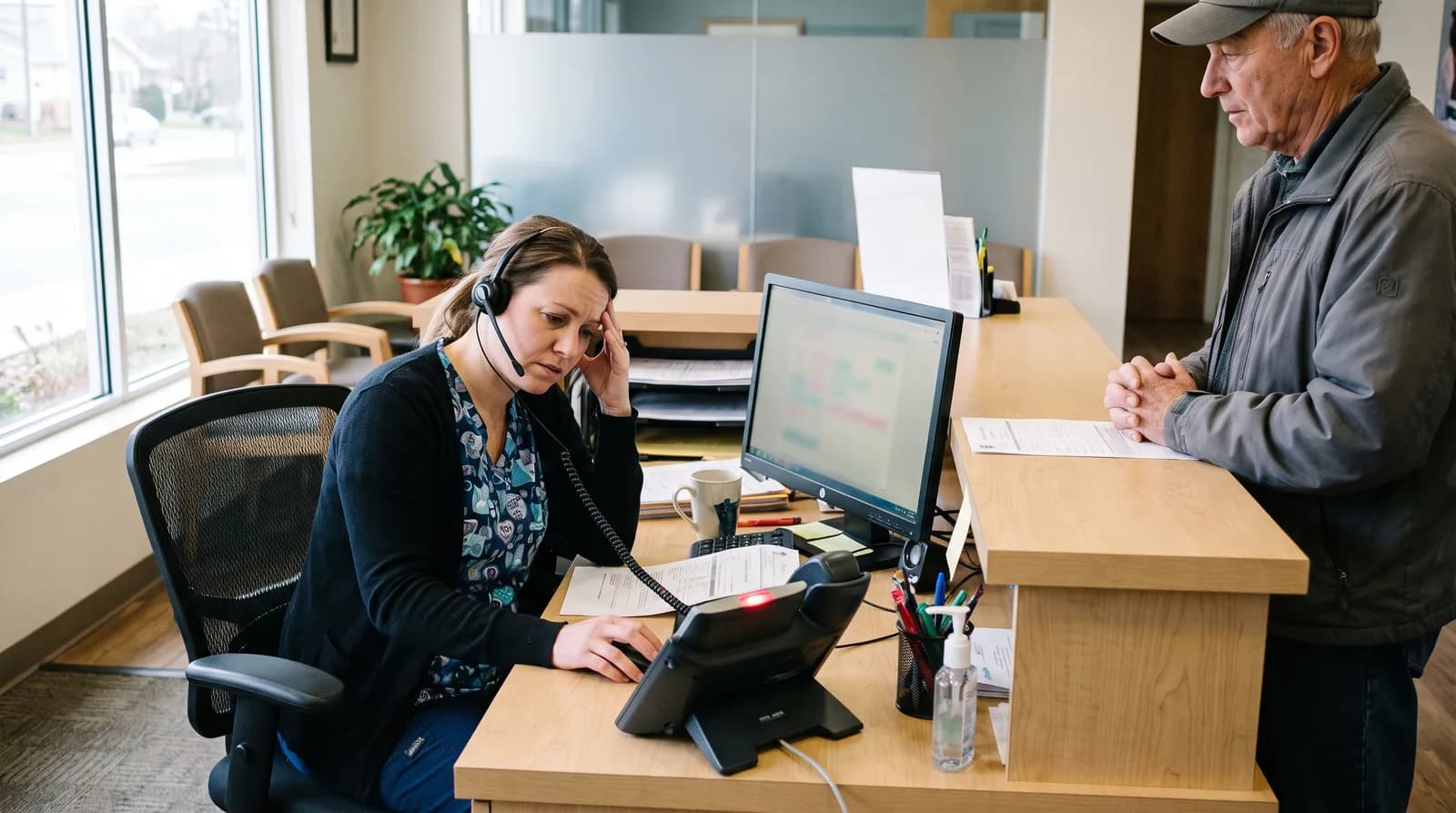
The patient at the counter carries part of the cost, too. They watch you answer a stranger first, wait through a call about parking, and wonder whether their own questions matter. Even a warm team can come across as distracted when the phone sets the pace.
What does one busy hour look like?
One busy hour at the front desk
Illustrative example, not measured data.
Three routine calls in under half an hour, and the counter lost its rhythm each time.
See how practices structure phone coverage
Different coverage models change how many calls reach your team at the busiest moments.
Read the dental phone coverage guide →What are 6 signs of dental front desk phone fatigue?
Six signs point to phone fatigue: rising small errors, short patience around ringing, skipped breaks, a growing voicemail pile, callbacks that never happen and staff who dread the phone. Seeing two or three together is a clear signal to change how calls reach your team.
- Small errors creep up. Misspelled names, wrong appointment types and missing notes show up more often, especially after busy stretches.
- Patience wears thin. A friendly greeting turns clipped by mid-afternoon, or someone sighs when the line rings.
- Breaks disappear. Lunch gets eaten at the desk because nobody else can cover the phone.
- Voicemail piles up. The morning list is long, and some callers never hear back.
- Callbacks slip. "I'll call them back" becomes a sticky note that gets buried.
- The phone becomes the dreaded task. Team members trade away phone duty or quietly avoid it.
How can you run a quick self-check?
Try a quick self-check. Ask each team member which part of the day feels loudest. The answer is rarely the busiest hour by patient count. It's usually the stretch when calls and counter traffic overlap. If several answers match, you've found your pressure point. For a longer list of overload signals, read dental front desk overwhelmed: 7 signs and real fixes.
Why do these signs show up together?
Because they share a cause. When calls arrive faster than your team can handle them, something gives. Break time goes first, then care with details, then patience. By the time voicemail is piling up, dental front desk phone fatigue has usually been building for weeks, which is why catching it early beats waiting for someone to resign.
Related: Seeing several of these signs often points to a coverage gap rather than a people problem. Dental Phone Coverage Models: In-House vs Service vs AI →
Which calls can be routed away from staff?
Routine, repeatable calls can be routed away from staff: office hours, location and parking, plans accepted, basic reschedule requests and new-patient details. Urgent, clinical and sensitive calls should still reach a person quickly, because those are the calls where judgment and empathy matter most.
How do you decide which calls go where?
The test is simple. Would two different team members give the same answer every time? If yes, the call is a good candidate for an AI receptionist to take first, with your team stepping in for anything that needs judgment. That's support, not substitution. Your people keep the calls that need empathy, clinical sense or a decision. For the logic behind sorting calls, see how AI triages urgent versus routine calls.
| Call type | Who takes it first | Why |
|---|---|---|
| Office hours, address, parking | AI receptionist | The answer is the same every time. |
| Insurance plans accepted (general) | AI receptionist, staff for details | Plan names repeat. Benefit specifics need a person. |
| New-patient inquiry | AI captures details, then hands off | Name, reason and contact info arrive without a wait. |
| Reschedule request | AI offers times your rules allow | Staff review changes that fall outside the rules. |
| Urgent pain or swelling | Immediate handoff to staff | Time-sensitive, and it needs clinical judgment. |
| Billing disputes, sensitive talks | Staff | These need empathy and authority. |
What do callers experience?
Callers notice the difference. What people hear when they reach your office decides whether they leave a message or try the next practice, and what callers hear on a dental office phone breaks that moment down. When the line backs up at peak times, handling dental call overflow without more staff shows how to catch the extra calls.
Before: every call hits the desk
- Every call rings the front desk, whatever it is.
- Staff stop check-in to answer hours and parking questions.
- Urgent and routine calls wait in the same line.
- Unanswered calls roll to a voicemail pile.
After: calls routed by type
- Routine calls are answered first by the AI receptionist.
- Urgent or complex calls go straight to a team member.
- Caller details are captured, so staff can call back with context.
- The counter stays focused on the patient in front of you.
Illustrative call routing setup. Your own rules decide which calls go where.
Let routine calls reach the AI receptionist first
DentiVoice answers repeatable calls and hands the rest to your team, so the counter stays focused on patients.
Explore AI receptionist guides →How do you set a calmer phone routine?
A calmer phone routine gives calls a clear owner, a clear order and clear limits. Decide who answers at each hour, which calls reach the AI receptionist first and when staff return messages, so the phone stops competing with the patient at the counter.

How do you build the routine?
Start with data you already have. Your phone system shows when the line is busiest, and dental office call volume patterns by hour explains how to staff to that curve. Then work through this routine.
- Find the loud hours. Pull one week of call logs and mark the three busiest stretches.
- Name a phone owner for each hour. Say who covers when that person is with a patient.
- Protect check-in. Give the counter its own person during the loudest hour, so calls never compete with the patient in front of you.
- Route routine calls first. List the calls the AI receptionist takes, and the situations that always go to a person.
- Set two callback windows. Mid-morning and mid-afternoon give messages a home, so sticky notes stop piling up.
- Hold a five-minute huddle. Start the day by naming the busy hours and who covers them.
How do you review it?
Then review every two weeks. Look at three things: how many callbacks went out the same day, how many entries needed correction, and what the team says about the phone. The ADA's practice management resources offer more ideas for organizing front office workflow, and the ADA Health Policy Institute tracks workforce trends if you want context on staffing.
What mistakes slow a calmer routine?
Two show up often. The first is treating phone duty like a rotating punishment, which spreads the stress around instead of reducing it. The second is sending too many calls to staff "just in case," so nothing really changes. Keep a short list of calls that always go to people, let everything else follow the routine, and adjust after two weeks. A calmer routine works better when the team helps write it.
Where to start this week
Dental front desk phone fatigue won't fade on its own, because the phone won't stop ringing. What you can change is how many calls land on your team at the worst moment.
Start small. Review one day of call logs, circle the loudest hour and decide which calls could be answered before they reach the desk. Try one change for two weeks, then ask your team how the phone feels.
Give Your Front Desk Room to Focus
DentiVoice handles routine calls and passes urgent or complex ones to your team, so the phone supports your day instead of running it.
See How DentiVoice Works →Want more practice management guidance?
Browse Practice Management articles →Frequently Asked Questions
Front desk phone fatigue is the mental drain from constant ringing and call after call while you also serve patients in person. It often appears as small errors, short patience and skipped breaks. It's a workflow problem more than a personal one, and better call routing usually eases it.
No single number fits every office, because call length, team size and patient traffic all matter. A better test is whether calls regularly interrupt check-in or leave voicemail unreturned. Track your loudest hours for one week, then compare call volume against the staff available.
An AI receptionist can take repeatable calls such as office hours, location, parking, general insurance questions and new-patient details. Urgent, clinical and sensitive calls should go to your team. Your scheduling rules and handoff settings decide where that line sits.
Give check-in its own owner, and let calls reach that person last. Send routine calls to an AI receptionist, route everything else to a second team member or a callback window, and keep the counter clear for the patient in front of you.
It can. Fewer interruptions give your team longer stretches of uninterrupted work, and routine calls stop piling up as voicemail. Results vary by office, so track callbacks, corrected entries and team feedback before and after you change your call routing.
Sources & References
- 1
- 2
- 3
- 4
- 5
Topics
Was this article helpful?
Written by
DentalBase Team
Expert dental industry content from the DentalBase team. We provide insights on practice management, marketing, compliance, and growth strategies for dental professionals.